
Biochemical Characterization of the Deubiquitylase USP48
Category: Research Poster
Author(s): Luke Busot
Presenter(s): Luke Busot
Mentors(s): Tingting Yao
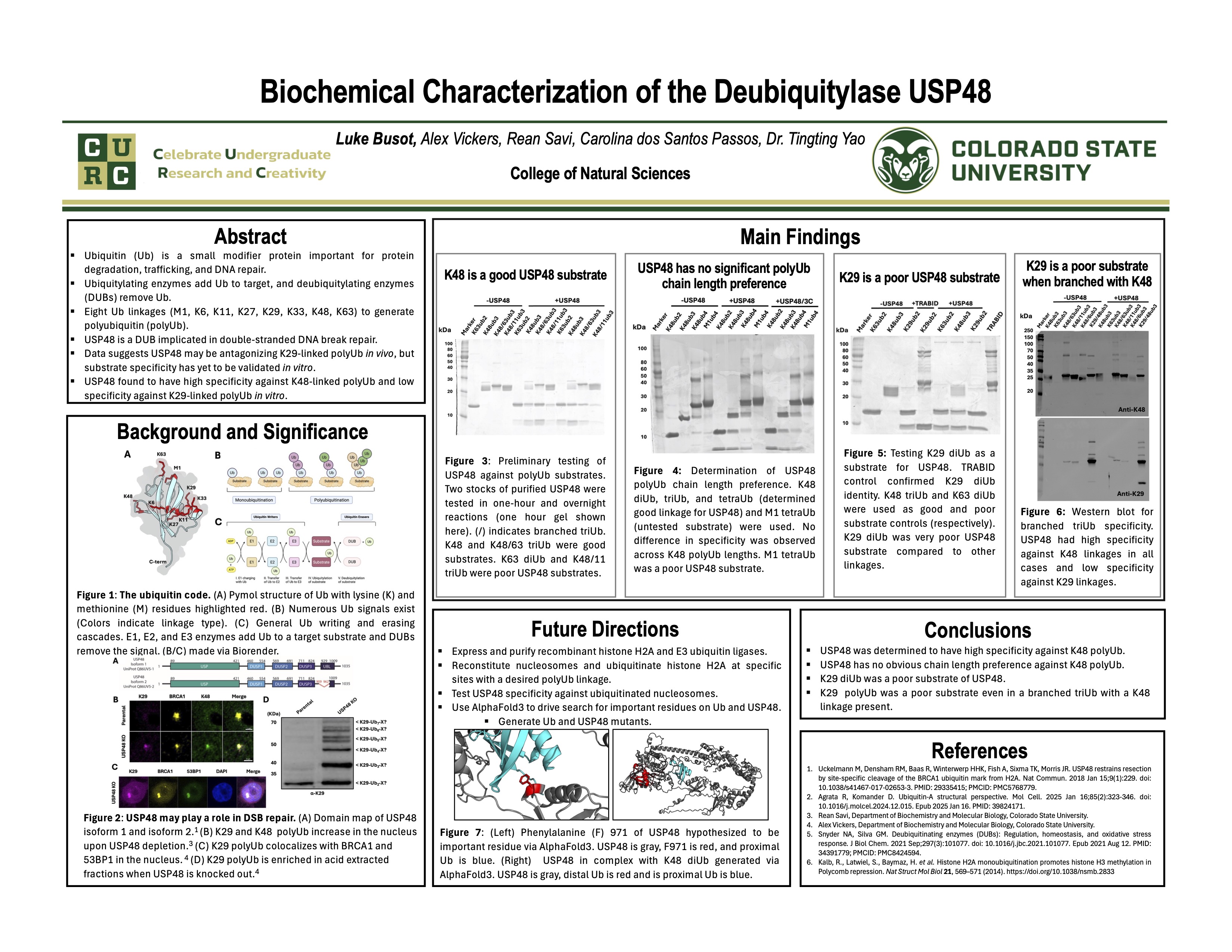
Ubiquitin is a small modifier protein used by cells for various processes, including protein degradation, trafficking, and as a signal for DNA repair. Once ubiquitin is added to a target substrate, deubiquitylating enzymes (DUBs) can remove the ubiquitin signal. Ubiquitin can be added to substrates as monoubiquitin or polyubiquitin chains, where ubiquitin polymers are added to the target. Eight unique linkages exist through conjugation of the C-terminus of ubiquitin and a lysine (K) or N-terminal methionine residue on a separate ubiquitin. These linkages can be combined to generate diverse polyubiquitin signals, and DUBs have varying specificity against certain linkage types. USP48 is a DUB that has been implicated in roles such as double-stranded DNA break repair. Various reports state that USP48 has specificity against numerous ubiquitin linkages, but its overall specificity has not been well characterized. Our data suggests that USP48 may be antagonizing K29-linked polyubiquitin chains involved in DNA double-stranded break repair in vivo, but its substrate specificity has yet to be validated in vitro. Here, we expressed and purified USP48 to evaluate its specificity against various polyubiquitin linkages. USP48 was found to have high specificity against K48-linked polyubiquitin and low specificity against K29-linked polyubiquitin. This may indicate USP48 is performing a different role in cells than previously hypothesized.