
Synaptic Dysfunction in Aged Canines with Canine Cognitive Dysfunction Syndrome
Category: Research Poster
Author(s): Karissa Crozier, Payton Shirley, Fiona Bowman, Stephanie McGrath, Julie Moreno
Presenter(s): Karissa Crozier
Mentors(s): Payton Shirley, Julie Moreno
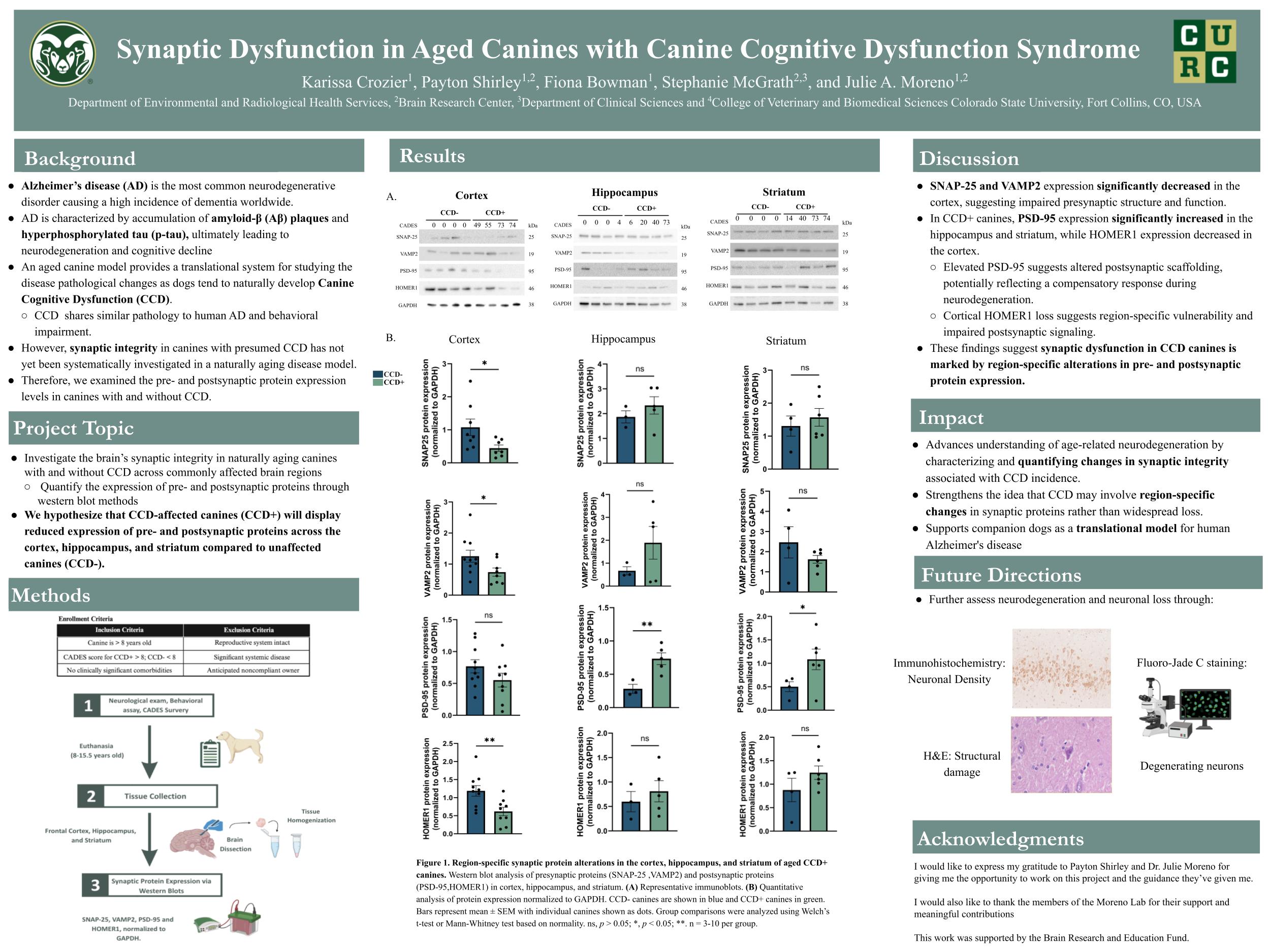
Alzheimer’s disease (AD) is a neurodegenerative disorder causing a high incidence of dementia worldwide. Aging being a primary risk factor for AD, an aged canine model provides a translational system for studying the disease’s pathological changes. This model is an efficient tool for studying age-related neuropathology as dogs naturally develop Canine Cognitive Dysfunction (CCD), a condition with pathological characteristics similar to human AD, including accumulation of misfolded proteins and neuroinflammation. Clinical manifestations of CCD are observed antemortem using the Canine Dementia Scale (CADES). CCD is confirmed postmortem through analysis of brain tissue and the presence of amyloid-beta (Aβ) and tau pathology. A CADES score above 8 with confirmed Aβ pathology provides evidence that the canine has CCD (CCD+). However, the effects on synaptic proteins, function, and synapse numbers in CCD+ canines remain unknown. To identify synaptic alterations associated with CCD, synaptic protein expression was investigated in homogenized brain tissue from the frontal cortex, hippocampus, and striatum, regions commonly affected in neurodegeneration. Hypothesizing that CCD-affected canines would show reduced expression of pre- and postsynaptic proteins compared to unaffected canines (CCD-). To test this hypothesis, we used western blotting to measure presynaptic proteins SNAP-25 and VAMP2, postsynaptic proteins PSD-95 and HOMER1, normalized to GAPDH. Analysis of blot band intensity quantified protein expression levels. Results show that in CCD+ canines, PSD-95 and HOMER1 expression increased in the hippocampus and striatum, suggesting postsynaptic scaffolding mechanisms were enhanced during neurodegeneration. However, SNAP-25 and VAMP2 were not significantly changed, likely due to conservation of presynaptic proteins.