
Is Déjà Vu with Places Previously Described in Writing Related to Mental Imagery Vividness?
Category: Research Poster
Author(s): Aurora Thorne
Presenter(s): Aurora Thorne
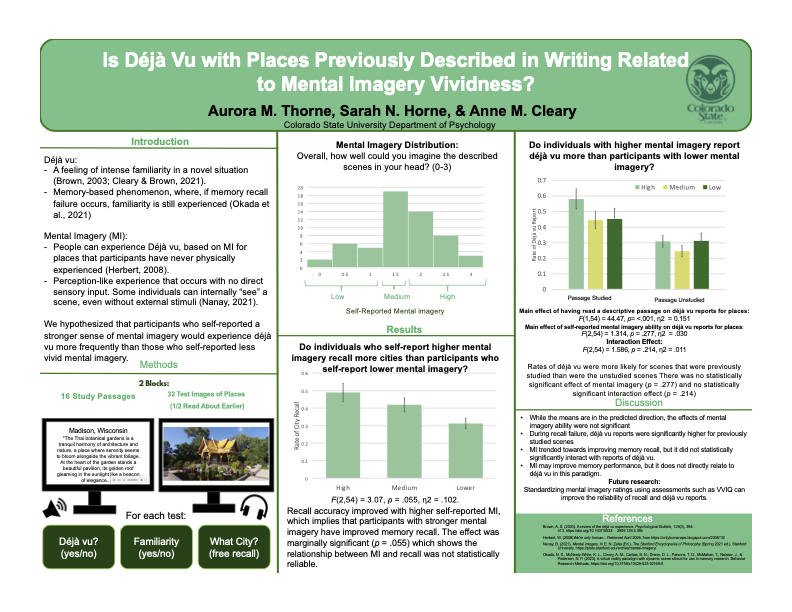
Déjà vu is defined as a feeling of intense familiarity in a novel situation (Brown, 2003; Cleary & Brown, 2021). Previous research has demonstrated that reports of it can be elicited using virtual reality paradigms meticulously designed to recreate spatial configurations similar to previously studied environments (Okada et al., 2023). Also, numerous pieces of anecdotal evidence point to the idea that déjà vu with a place can arise from a vivid description previously read in a literary work (Herbert, 2008). To examine whether déjà vu with a place can be brought on by having previously read a vivid description of the place, we analyzed how the frequency of self-reported déjà vu in Google Earth scenes from cities around the world was associated with participants’ reported vividness of mental imagery. Participants (n = 58) were instructed to listen to and simultaneously read a series of AI-generated literary passages describing a scene from a specific city from around the world. In a later phase, the participants saw Google Earth images, half of which corresponded to a previously studied passage. While in a scene, participants were asked to indicate if they felt déjà vu, indicate if it felt familiar, and attempt to identify the city. At the end of each study-test block, they were asked to self-report their mental imagery vividness on a four-point Likert scale (0 = very poorly, 3 = very well). We hypothesized that participants who self-reported a stronger sense of mental imagery would experience déjà vu more frequently than those who self-reported less vivid mental imagery.