
Measuring Social Support in Emerging Adults: A comparison of Three Scales
Category: Research Poster
Author(s): Eden Hailu, Emily Merz, Lydia Jacobs, Melissa Hansen
Presenter(s): Eden Hailu
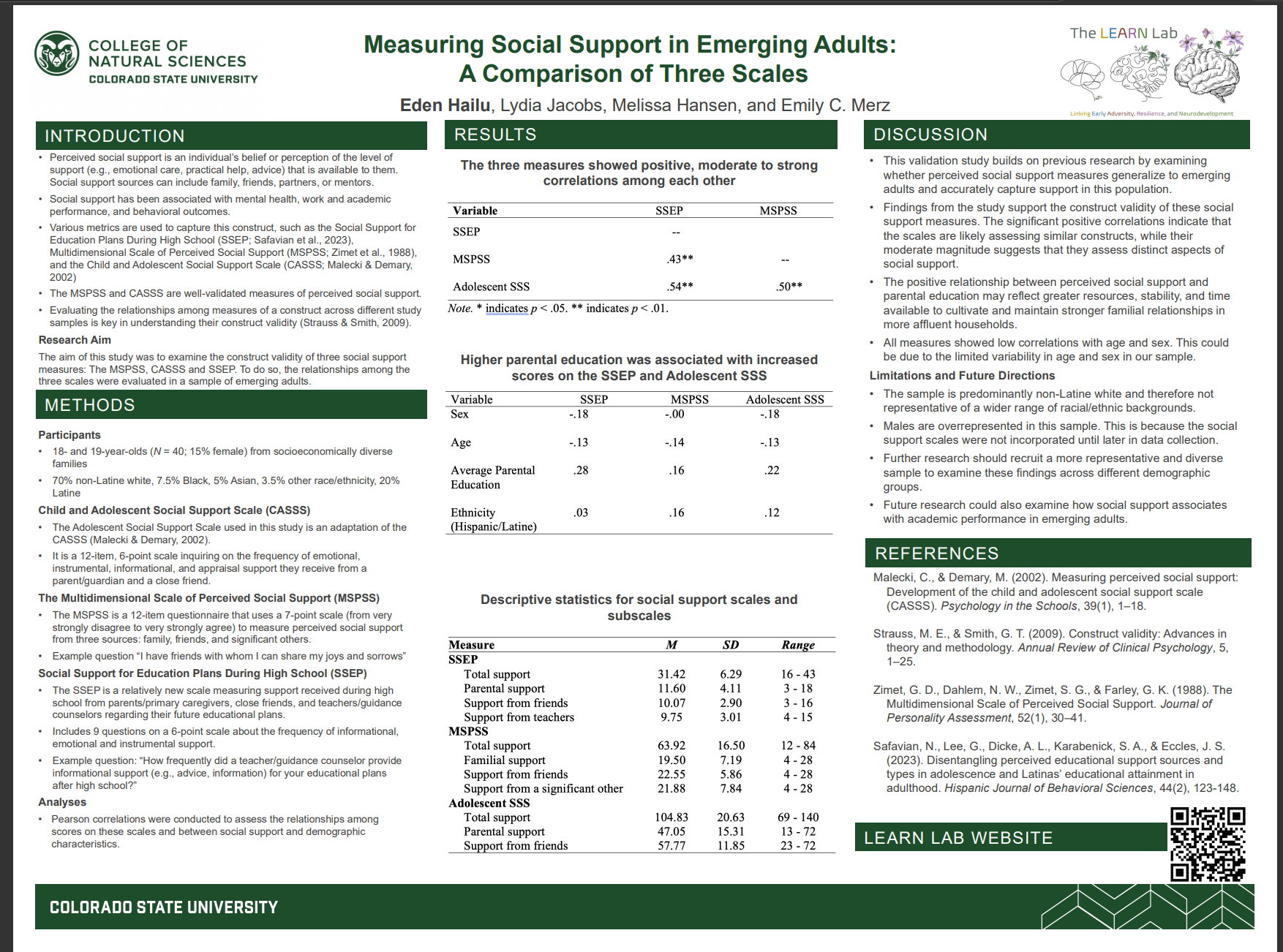
Evaluating the relationships among measures of a construct across different study samples is key in understanding their construct validity (Strauss & Smith, 2009). The current study examined three scales of social support in a larger study of emerging adults: The Multidimensional Scale of Perceived Social Support (MSPSS; Zimet et al., 1988), Child and Adolescent Social Support Scale (CASSS; Malecki & Demary, 2002), and Social Support for Education Plans (SSEP). These scales assess types of support received from an individual's social network (e.g., family, friends, teachers), including emotional, instrumental and informational support. Forty 18–19-year-olds (85% female, 70% non-latine white) from socioeconomically diverse backgrounds completed the three metrics via computerized surveys. Pearson correlations were conducted to assess the relationships among these scales and sample demographics. The three measures showed positive, moderate to strong correlations among each other (r = .43-.54, p < .01). Higher parental education was associated with increased social support, the strongest association being observed for the SSEP (MSPSS: r = .16; CASSS: r = .22; SSEP: r = .28). All measures showed low correlations with age and sex. Overall, our findings support the validity of these measures as useful, but distinct tools for measuring social support among emerging adults. The positive relationship between perceived social support and parental education may reflect greater resources, stability, and time available to cultivate and maintain stronger familial relationships in affluent households. This study provides insights into the measurement of social support, a construct widely recognized as important for healthy adolescent development.