
Avian Migration Under Artificial Skies: A Study of Light Pollution's Ecological Impacts
Category: Research Poster
Author(s): Leona Myers
Presenter(s): Leona Myers
Mentors(s): Anping Chen
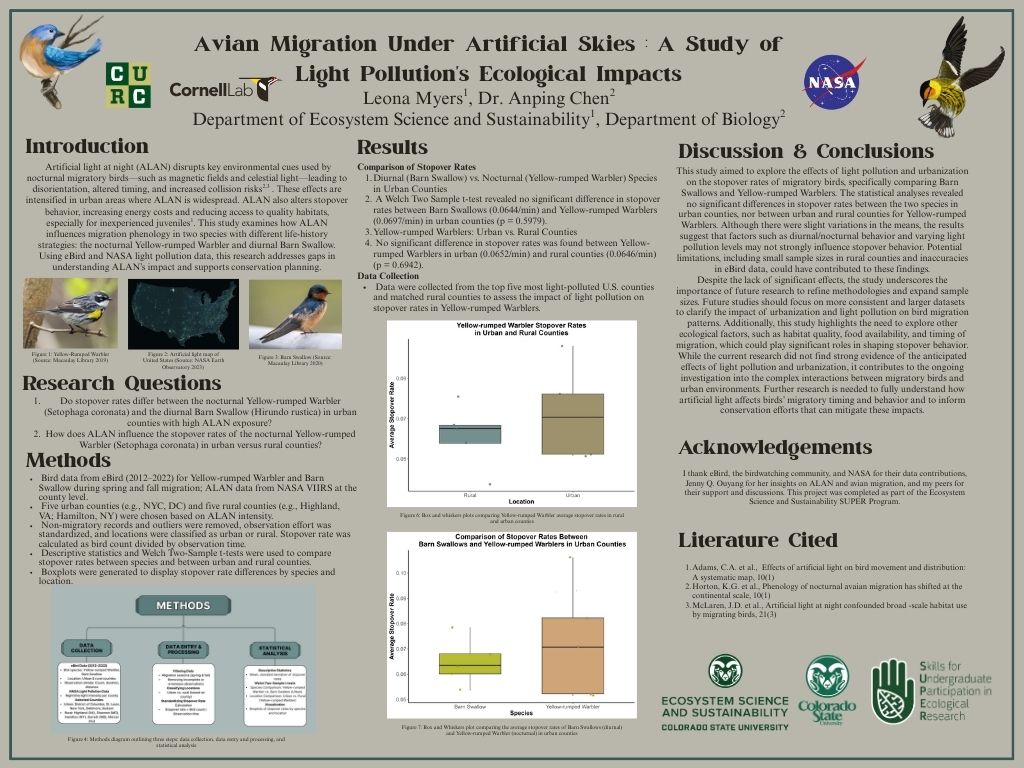
Artificial light at night (ALAN) has been shown to disrupt biological rhythms in migratory birds, yet its effects on migration timing across large geographical ranges remain unclear. Understanding these effects is critical for assessing human-induced impacts on avian migration and informing conservation strategies. This study examines how ALAN influences stopover rates of Yellow-rumped Warblers (Setophaga coronata) and Barn Swallows (Hirundo rustica) along an urban to rural gradient using eBird observational data (2012–2022) and ALAN exposure levels derived from NASA satellite imagery. Data processing included filtering for migration seasons, categorizing urban and rural counties, standardizing observation counts, and analyzing bird migration stopover rates relative to light pollution intensity. Welch two-sample t-tests were conducted to compare stopover rates between species and between urban and rural counties. Preliminary results show no significant differences in stopover rates between urban and rural counties, nor between Yellow-rumped Warblers and Barn Swallows in urban areas. These findings suggest that ALAN may not significantly affect migration timing or stopover behavior in the species studied, at least under the conditions observed. Future research should focus on expanding sample sizes, refining methods for measuring stopover behavior, and exploring other environmental factors that may influence migratory patterns.