
Global Political Biogeography of Country-Endemic Bird Species
Category: Research Poster
Author(s): Kate Laidlaw, Margaret Monaghan
Presenter(s): Kate Laidlaw, Margaret Monaghan
Mentors(s): Sandra Duran Mancipe, Eduardo Gallo Cajiao
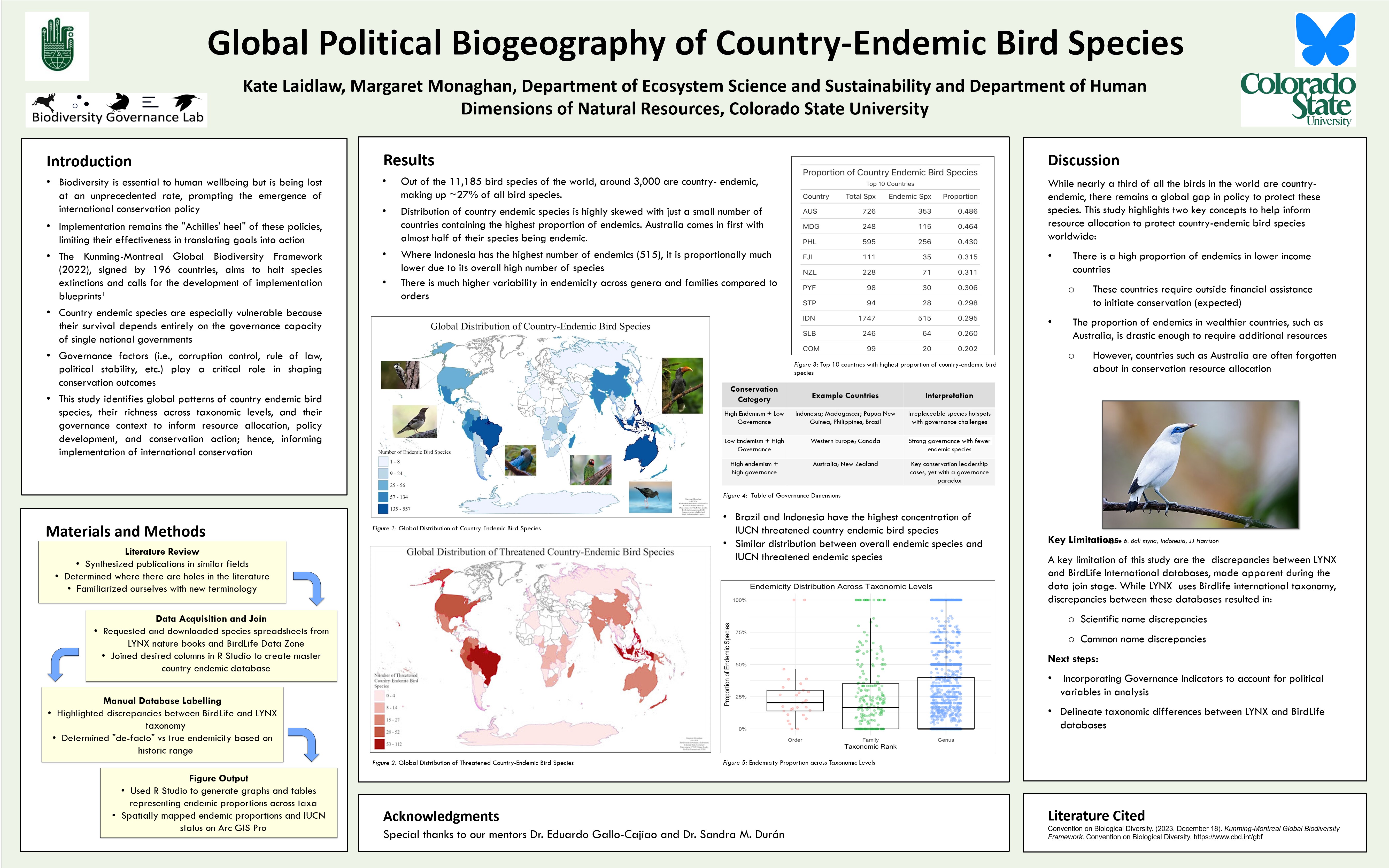
Of all known bird species on Earth, an estimated third occur within single countries. These species are known as country-endemic. Such species are of special conservation concern as they are reliant on the governance context of single countries, which has been dubbed as the doctrine of ultimate national responsibility. These species are of high conservation concern because they are subject to high irreplaceability, conservation capacity deficits, and threat intensity. Against this backdrop, no study has yet assessed the spatial patterns of country-endemic bird species to identify areas of conservation priority to inform resource mobilization internationally. The goal of this study is to develop a baseline of understanding of where these country-endemic bird species are concentrated, what their conservation status is based on the International Union for Conservation of Nature’s Red List of Threatened Species, what governance context they occur in, and the extent to which these species' geographic ranges are covered by protected areas using different spatial analysis tools. Our preliminary results indicate that 3,314 bird species are country-endemic, which corresponds to roughly a third of all known bird species in the world. Of these country-endemic species, a third occur within only five countries: Indonesia, Australia, Brazil, the Philippines, and Peru. Establishing areas of conservation priority for country-endemic bird species can help direct resource allocation, research, policy, and other tools to conserve biodiversity, habitats, and critical evolutionary processes.