
Bat Biodiversity and Activity Analysis in Ecuador
Category: Research Poster
Author(s): Sofia Ambriz, Mary Nord
Presenter(s): Sofia Ambriz, Mary Nord
Mentors(s): Tanya Dewey
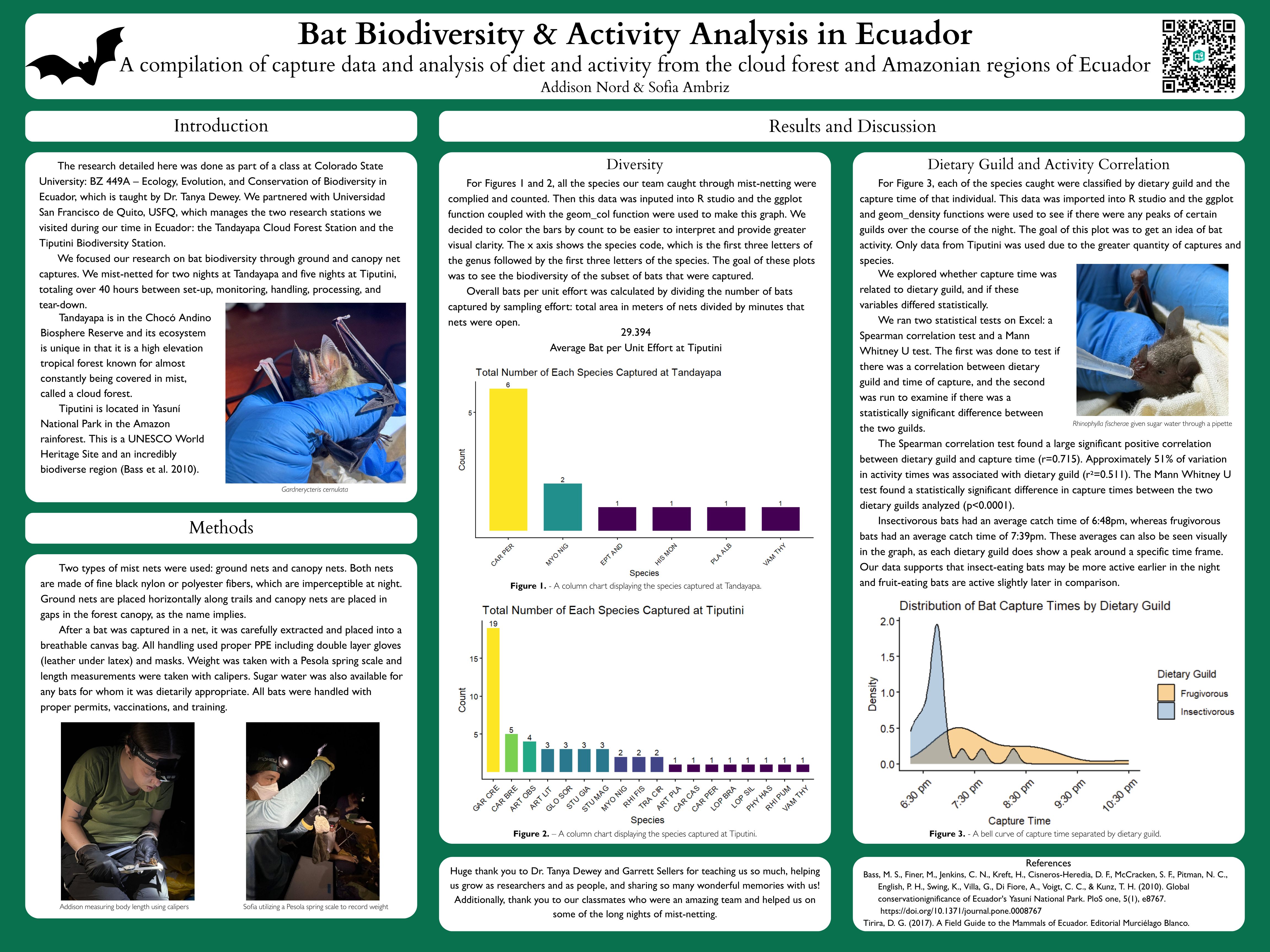
This study was conducted at two research stations in Ecuador: Tiputini Biodiversity Station, located in Yasuní National Park in the Amazon rainforest and Tandayapa Cloud Forest Station, which is in the Chocó Andino Biosphere Reserve. The aim was to use mist net and canopy net captures to gain a better understanding of bat diversity and the relationship between diet and foraging times in these understudied yet ecologically important regions. Twelve individual bats across six different species were caught at Tandayapa and fifty-four individuals in eighteen species were caught at Tiputini, which is only a small fraction of the known species richness of Chiropterans in this area (Tirira, 2017). Utilizing the catch data, we aimed to make an inference about foraging activity via dietary guild, frugivorous or insectivorous, of bats caught and capture time. Through statistical analysis, a large significant positive correlation between dietary guild and time of capture was found (r=0.715). Approximately 51% of variation in activity times was associated with dietary guild (r^2=0.511). Along with this, a statistically significant difference in capture times was seen between dietary guilds (p<0.0001). While there are limitations in our findings due to our small dataset and short time duration, these preliminary results can inform future research and be critical in continuing to learn about and conserve these species in this extremely biodiverse region.