
Coding the Bridge: Developing a Wildlife Disease Outbreak Model to Overcome Current Deficiencies in SIR Models
Category: Research Poster
Author(s): Bianca Anderson
Presenter(s): Bianca Anderson
Mentors(s): Antony Cheng
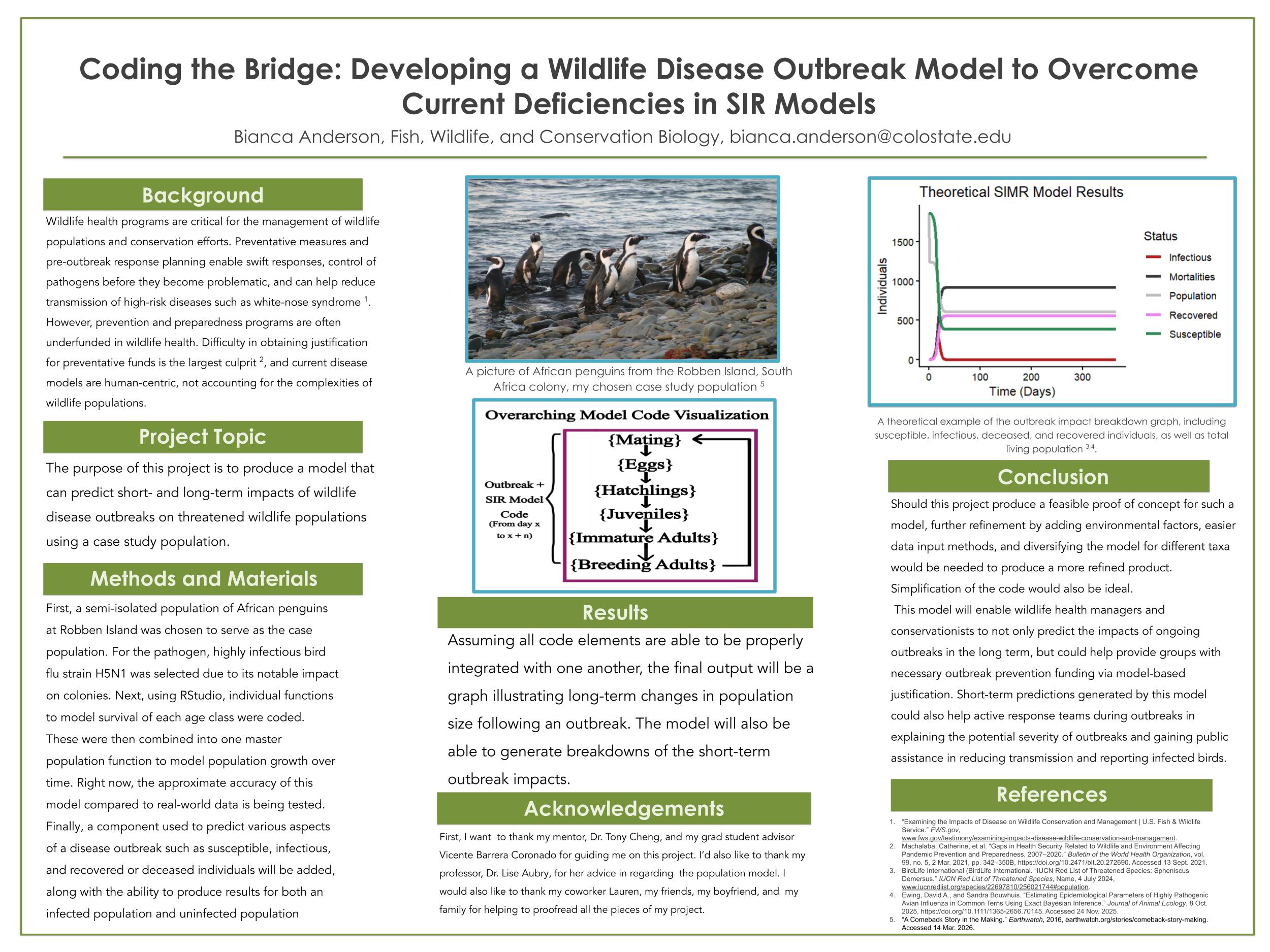
Historically, human-centric Susceptible-Infectious-Recovered (SIR) disease models produce inaccurate predictions of outbreak impacts on wildlife populations, leaving wildlife health programs under-resourced for preemptive outbreak management. This is because current models fail to account for the wider range of mortality cases facing wildlife populations – including predation, plus higher rates of fatal abandonment, disease, and starvation – compared to humans. The goal of this project is to create a model that overcomes these deficiencies by incorporating age-class-based mortality data and other population dynamics. I chose the relatively isolated African penguin colony at Robben Island, South Africa, as my model-testing population, and the highly pathogenic avian influenza strain H5N1 as the disease. Individual age-class functions were coded, including age-based mortality rates and “advancement odds” to the next age class in multi-year transitory stages, like juveniles. A set of nested loops was then created with these functions inside to establish annual time progression for an input amount of years. A sensitivity analysis using known breeding-pair data is being conducted to assess the population model’s accuracy. Finally, an SIR component with transmission, mortality, and recovery rates will be added, along with code to plot the unaffected population against outbreak-affected population outcomes. When completed, I expect the model will show negative short- and long-term impacts on the study colony, with notable longer-term effects on colony survival. Next steps for this project include adding migratory effects, incorporating environmental dynamics, further refining and testing the model using real-world empirical data, and producing a mammal-focused equivalent to this avian-focused model.