
Identifying areas of high connectivity for the Greater Sage-Grouse in a warmer world
Category: Research Poster
Author(s): Sarah Culhane, Sergio Nicasio, Julie Heinrichs
Presenter(s): Sarah Culhane
Mentors(s): Sergio Nicasio
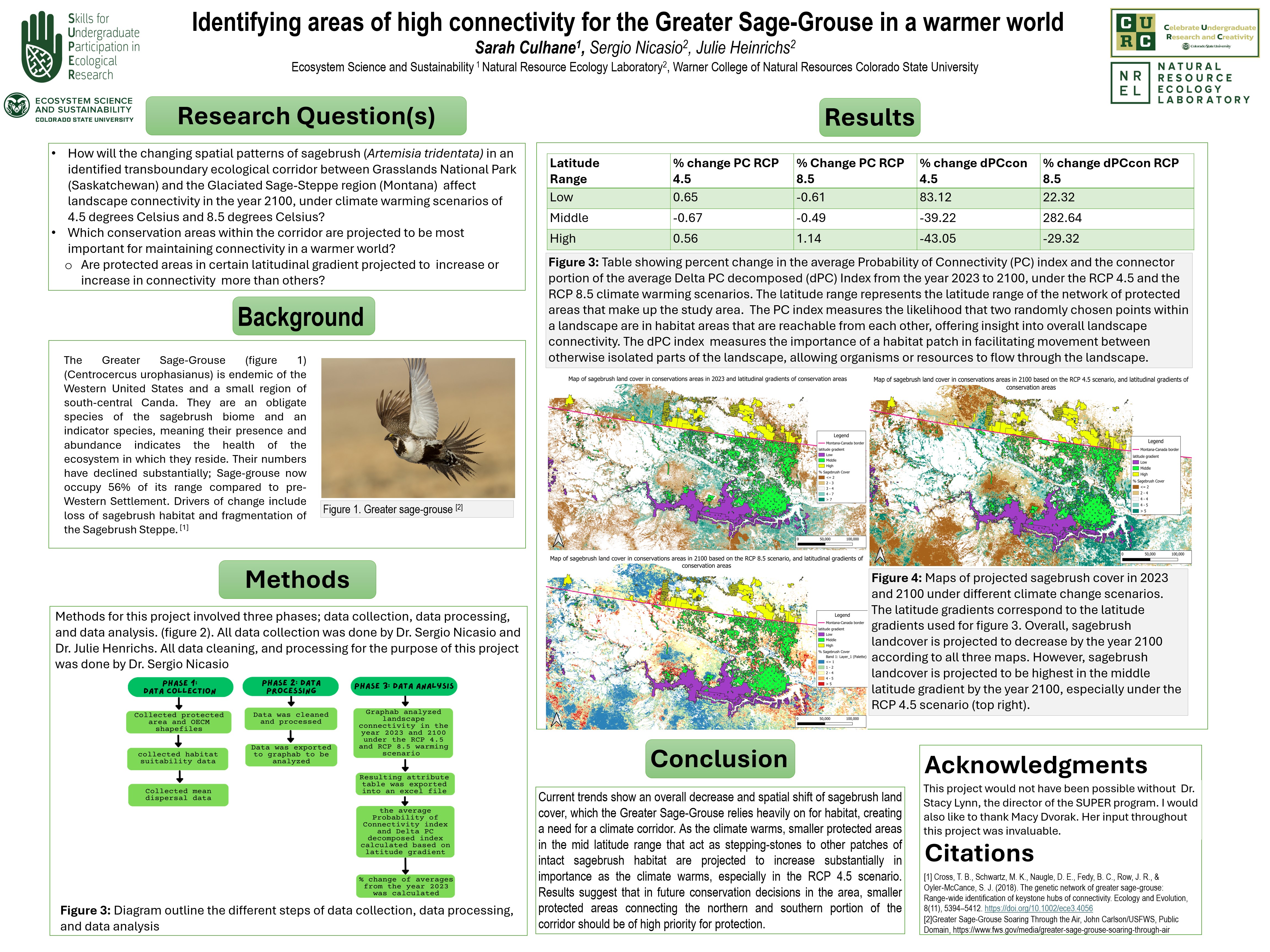
The Sagebrush Steppe provides essential habitat and other ecosystem services for the Greater Sage-Grouse (Centrocercus urophasianus) and other species, but landscape fragmentation in recent years and loss of intact sagebrush cover has caused a significant decline in the Greater Sage-Grouse population. This study assesses the capability of Qgis and graphab analysis to accurately demonstrate the current and future state of landscape connectivity within an identified transboundary ecological corridor between Grasslands National Park in Saskatchewan, Canada, and the Glaciated Sage-Steppe region of Montana, a crucial migration pathway for the Greater Sage-Grouse and other sagebrush obligate species in the Sagebrush Steppe. When put through climate warming scenarios of 4.5 degrees Celsius and 8.5 degrees Celsius, shifts in landscape connectivity are expected, with some areas losing connectivity and other areas gaining connectivity, fragmenting the landscape and impacting the ability of the Greater Sage-Grouse to move unimpeded in between habitat patches. The results of this study can potentially be used to aid in current conservation planning supporting the current and future population of the Greater Sage-Grouse in the Sagebrush Steppe.