
fNIRS Investigation of Mental Workload in the Executive Control Network
Category: Research Poster
Author(s): Nina Miller, Emma Sullivan
Presenter(s): Nina Miller, Emma Sullivan
Mentors(s): Sierra Swenson, Michael Thomas
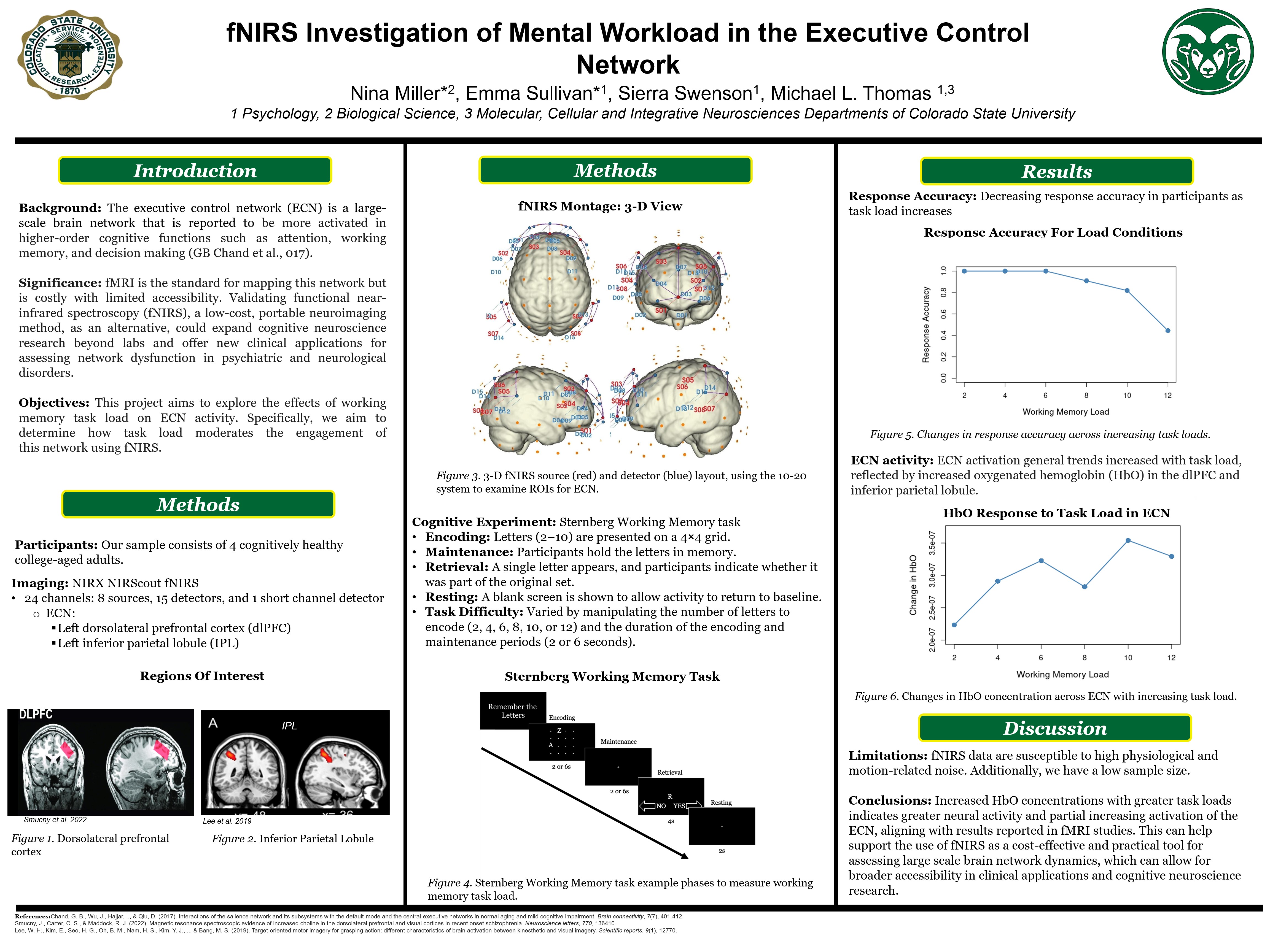
Prior research using functional magnetic resonance imaging (fMRI) has demonstrated cognitive load-dependent changes in engagement within the executive control network (ECN). This study seeks to determine whether functional near-infrared spectroscopy (fNIRS), a low-cost, portable neuroimaging method, can detect subtle modulation in the executive control network during a working memory task. Doing so would support the use of more accessible tools for cognitive neuroscience research beyond traditional laboratory and medical settings. This project aims to confirm the effects of working memory task performance on load-dependent changes within the ECN. Specifically, we aim to determine how task load moderates brain activity of this network using fNIRS. This study has just begun data collection and is still in progress. Our current sample contains four, cognitively healthy, college aged participants. Participants completed a Sternberg working memory task with varying task difficulty achieved through differing memory loads. Preliminary data analysis was conducted on our current sample. We found that as task load increased, accuracy decreased, confirming that our load conditions were more cognitively demanding. fNIRS recordings were also analyzed to assess activity between two cortical regions associated with the ECN, the dorsolateral prefrontal cortex and the inferior parietal lobule. We found increased activation within the ECN while memory load increased. These results are promising and consistent, finding what fMRI literature has demonstrated. Establishing fNIRS as an effective measure of the ECN could have wide-ranging applications in clinical assessments for psychiatric and neurological populations with disrupted brain activity.