
Sustaining Connectivity of the Greater Sage-Grouse Ecosystem in Increasing Warming Scenarios
Category: Research Poster
Author(s): Macey Dvorak, Sergio Nicasio, Julie Heinrichs
Presenter(s): Macey Dvorak
Mentors(s): Sergio Nicasio
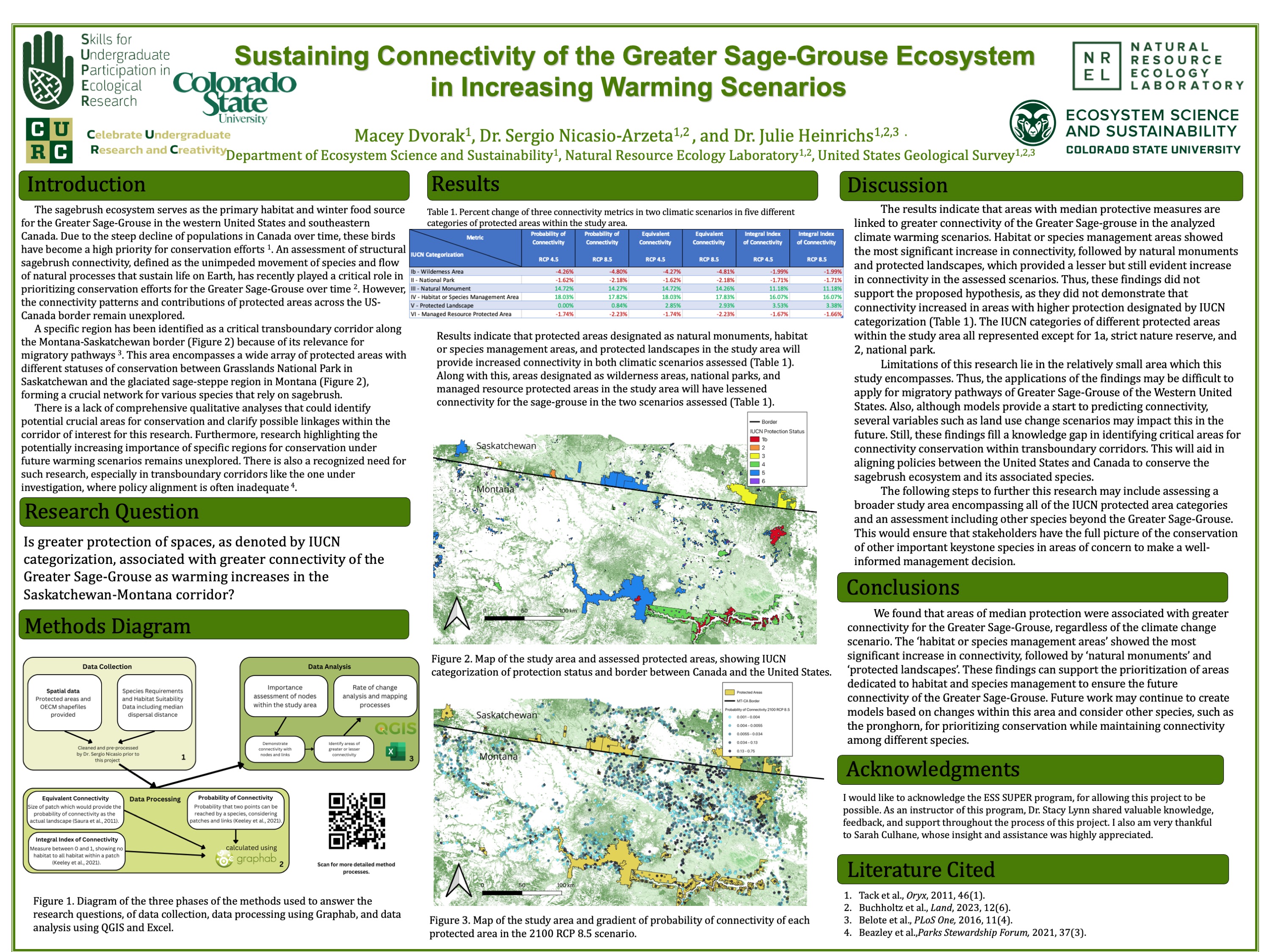
The transboundary corridor between northern Montana and southern Saskatchewan provides a significant and important ecosystem for migration of the Greater Sage-Grouse. Ecological habitat connectivity of the species is of great importance as well, and different parcels of protected areas are expected to change in importance of this connectivity under different warming scenarios. This project answers the question of if greater protection of conserved parcels of land, as denoted by IUCN categorization, are associated with greater connectivity of sage grouse as warming increases in the Saskatchewan-Montana corridor. Spatial data of protected areas, species habitat suitability requirements, and habitat suitability data was used in order to process and analyze data. The software Graphab was used to calculate key metrics for connectivity, which was then analyzed using QGIS to assess importance of nodes, links, as well as allowing the data to be visualized through mapping processes. Conclusions could lead to various implications for conservation, as well as recommendations for increasing areas of certain protection status in order to preserve connectivity as much as possible throughout this transboundary ecosystem.