
Neuropathological Evaluation of Neuronal Degeneration in Dogs with Canine Cognitive Dysfunction
Category: Research Poster
Author(s): Fiona Bowman, Julie Moreno, Payton Shirley, Karissa Crozier, Stephanie McGrath, Olivia Lowe, Rebecca Fultz
Presenter(s): Fiona Bowman
Mentors(s): Julie Moreno, Payton Shirley
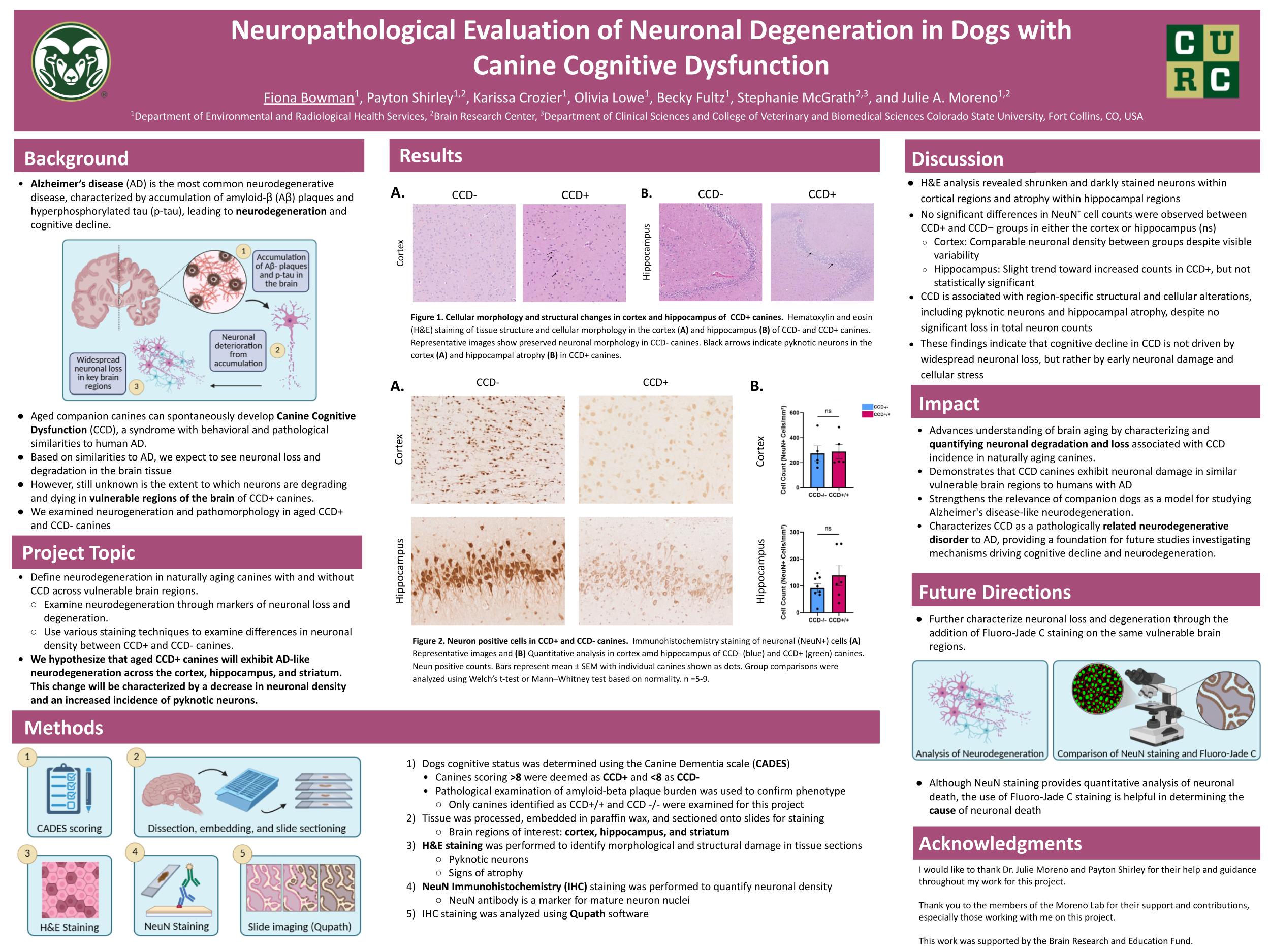
Aged canines spontaneously develop Canine Cognitive Dysfunction (CCD) syndrome, a neurodegenerative disorder sharing similar neuropathological features with Alzheimer's disease (AD) including Amyloid-Beta (Aꞵ) plaques and hyperphosphorylated tau (P-tau). In AD, these pathological proteins misfold and accumulate within the brain leading to synaptic dysfunction and neuronal loss. This aggregation is highly toxic to neurons, impeding cognitive function and accelerating neuronal degradation. What remains unknown is the extent to which neurons are degrading and dying in key regions of the brain involved in neurodegeneration in CCD+ canines. This study examines neuronal degeneration in aged canines with presumed CCD. We hypothesize that there will be a significant increase of neuronal loss in vulnerable brain regions. Cognitive status of canines will be evaluated through the Canine Dementia Scale (CADES) and Aβ pathology, by which they are identified as CCD- or CCD+. Postmortem brain tissue from the cortex, hippocampus, and striatum will be collected for histological analysis. Immunohistochemistry (IHC) staining uses NeuN, a marker for mature neuron nuclei to visualize neuronal loss. Presence of pyknotic neurons and atrophy will be evaluated via H&E staining. H&E analysis revealed shrunken and darkly stained neurons within cortical regions and atrophy within hippocampal regions of CCD+ canines. This will be coupled with Fluoro-Jade C staining to evaluate degenerating neurons confirming pyknosis. Neuronal density analysis is ongoing, but we expect increased neuronal loss in vulnerable brain regions via IHC. Together, these findings aim to evaluate neuronal loss in aged canines with CCD, revealing pathological features shared with AD.