
Dendritic Spine Dynamics and Structural Plasticity in Reward Circuitry
Category: Research Poster
Author(s): Jordan Russelavage, Levi Flom
Presenter(s): Jordan Russelavage
Mentors(s): Ana Clara Bobadilla
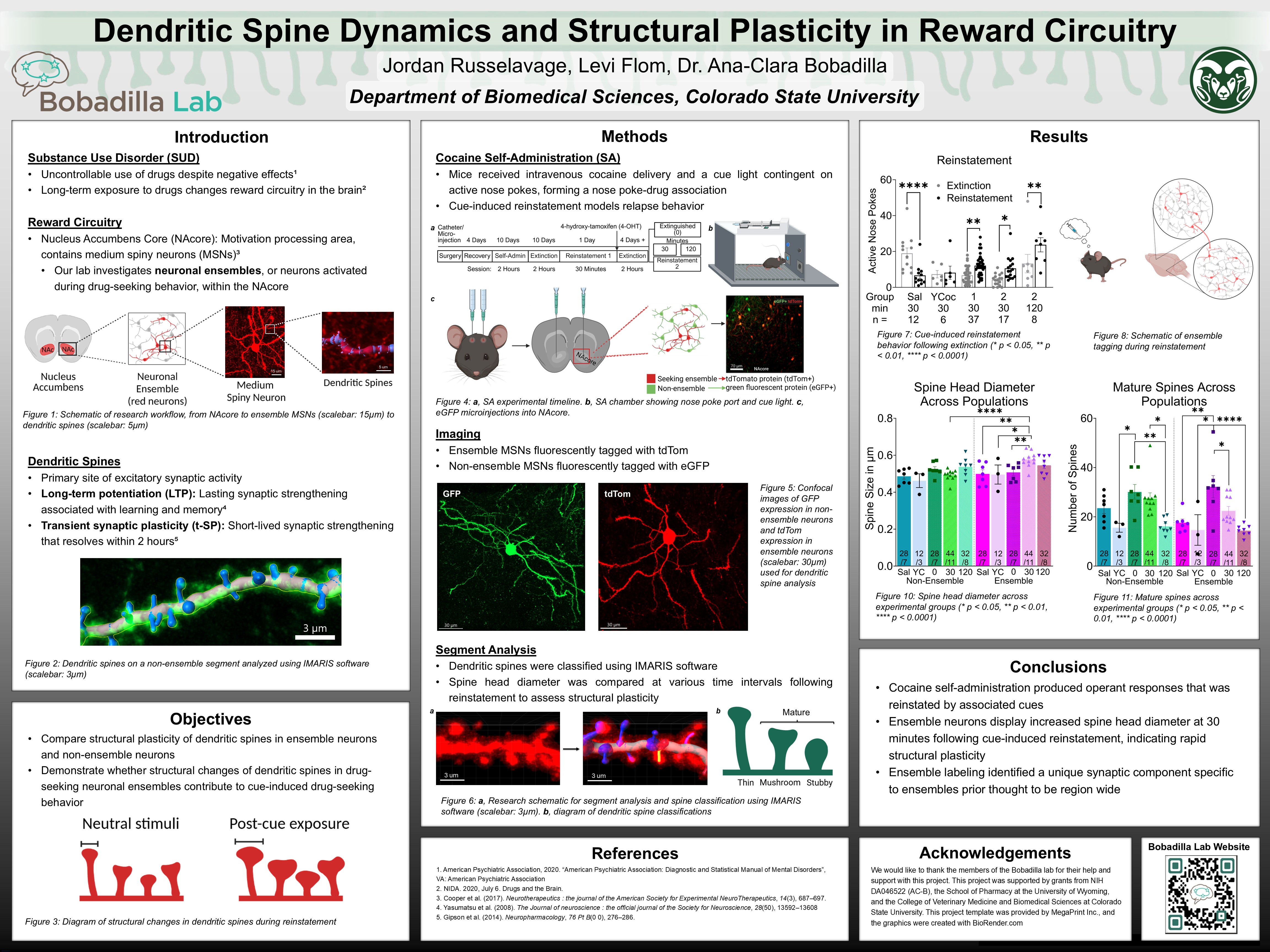
Substance use disorder (SUD) affects millions of individuals globally. Long-term exposure to drugs causes changes in the reward circuitry in the brain, specifically impacting dendritic spines. Dendritic spines are small, dynamic protrusions on neuronal dendrites that form excitatory synapses in the brain, allowing neurons to communicate and support learning. The shape and density of dendritic spines change in response to experience and learning during drug-seeking events; therefore, making them key structural indicators of neuroplasticity. The Bobadilla Lab investigates how dendritic spines within drug seeking neuronal ensembles, also known as groups of neurons activated together during cocaine-seeking, undergo structural and functional plasticity. In this project, cocaine seeking ensembles in mice are tagged using the Targeted Reactivation of Active Populations (TRAP) system, a genetic method that permanently labels neurons active during cocaine-seeking behavior, allowing selective visualization of these neurons with confocal microscopy. Spine morphology and density are then quantified using IMARIS to assess structural remodeling following cocaine exposure and reinstatement of cocaine seeking. This approach reveals how cocaine alters synapses within behaviorally relevant ensembles. Understanding spine level plasticity in reward circuitry may help identify ensemble specific mechanisms that contribute to drug seeking and could inform future therapeutic strategies.