
Development of Crop-Specific Response Functions to Tropospheric Ozone
Category: Research Poster
Author(s): Will Selvidge, Danica Lombardozzi
Presenter(s): Will Selvidge
Mentors(s): Danica Lombardozzi
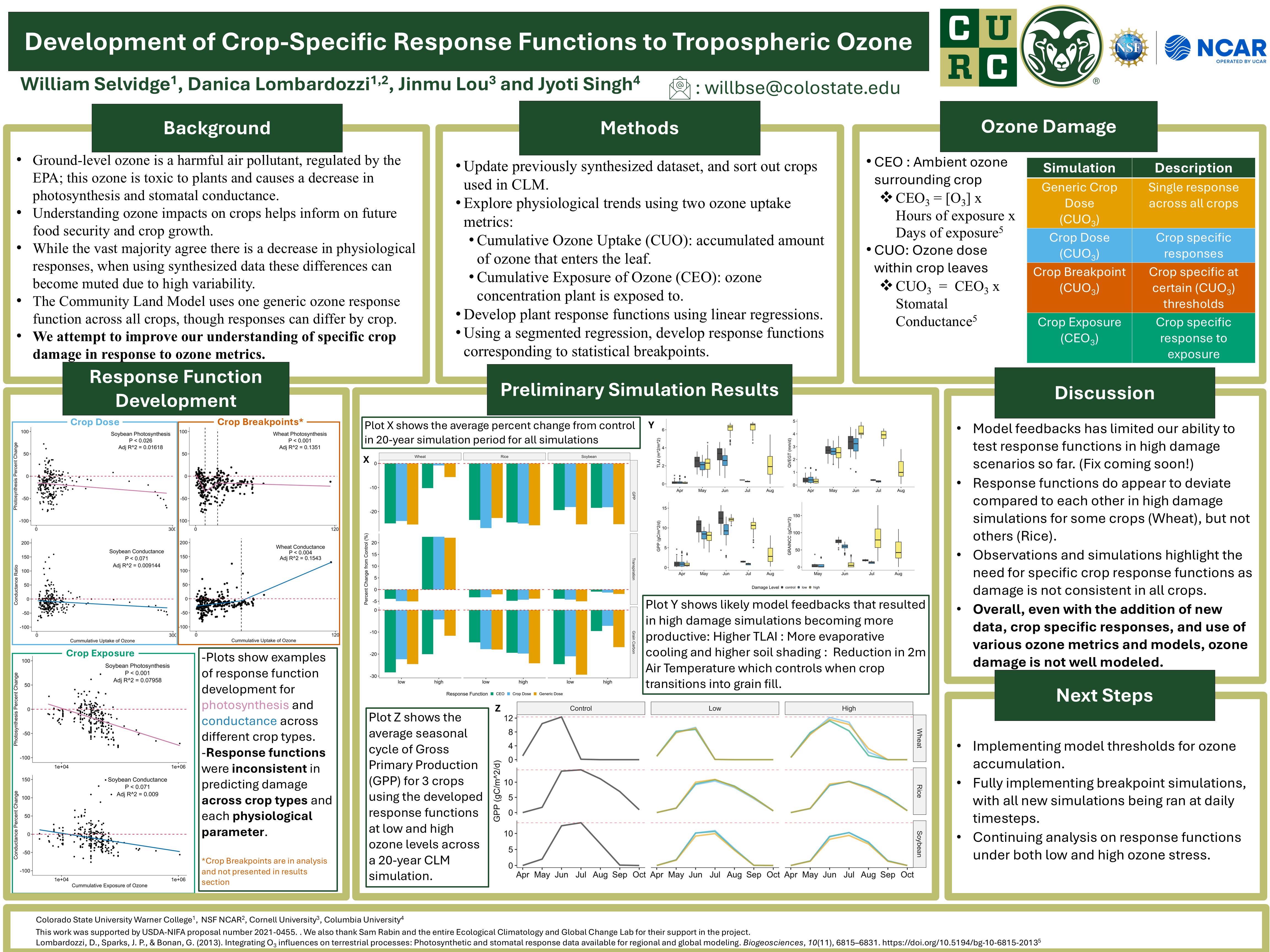
Tropospheric ozone (O3) is a major pollutant, formed through chemical reactions with nitrogen oxides (NOx), volatile organic compounds (VOCs), and sunlight. This ozone damages plant physiological processes when present in high enough concentrations. While literature suggests plant photosynthesis and stomatal conductance are negatively impacted by O3 exposure, there are limited studies that examine these physiological impacts using compiled datasets. Studies that have done so have had limited success in determining conclusive physiological damage in crops and often do not differentiate by individual crop types. Here we compiled a dataset from multiple published studies to examine O3 exposure on different crop types used within the Community Land Model (CLM). Using site level simulations in CLM, we tested multiple response functions using various modeling techniques and predictor variables, evaluating changes in crop productivity and yield. We find that individual crop responses vary to increased O3 exposure and that significant variability in stomatal conductance responses can mask ozone damage relationships. The results illustrate the importance of crop-specific response functions to improve model accuracy and better assess future agricultural impacts.