
Designing Forensic Chemistry Labs
Category: Research Poster
Author(s): Lindsay Santi, Haley Howard
Presenter(s): Lindsay Santi, Haley Howard
Mentors(s): Carlos Olivo-Delgado
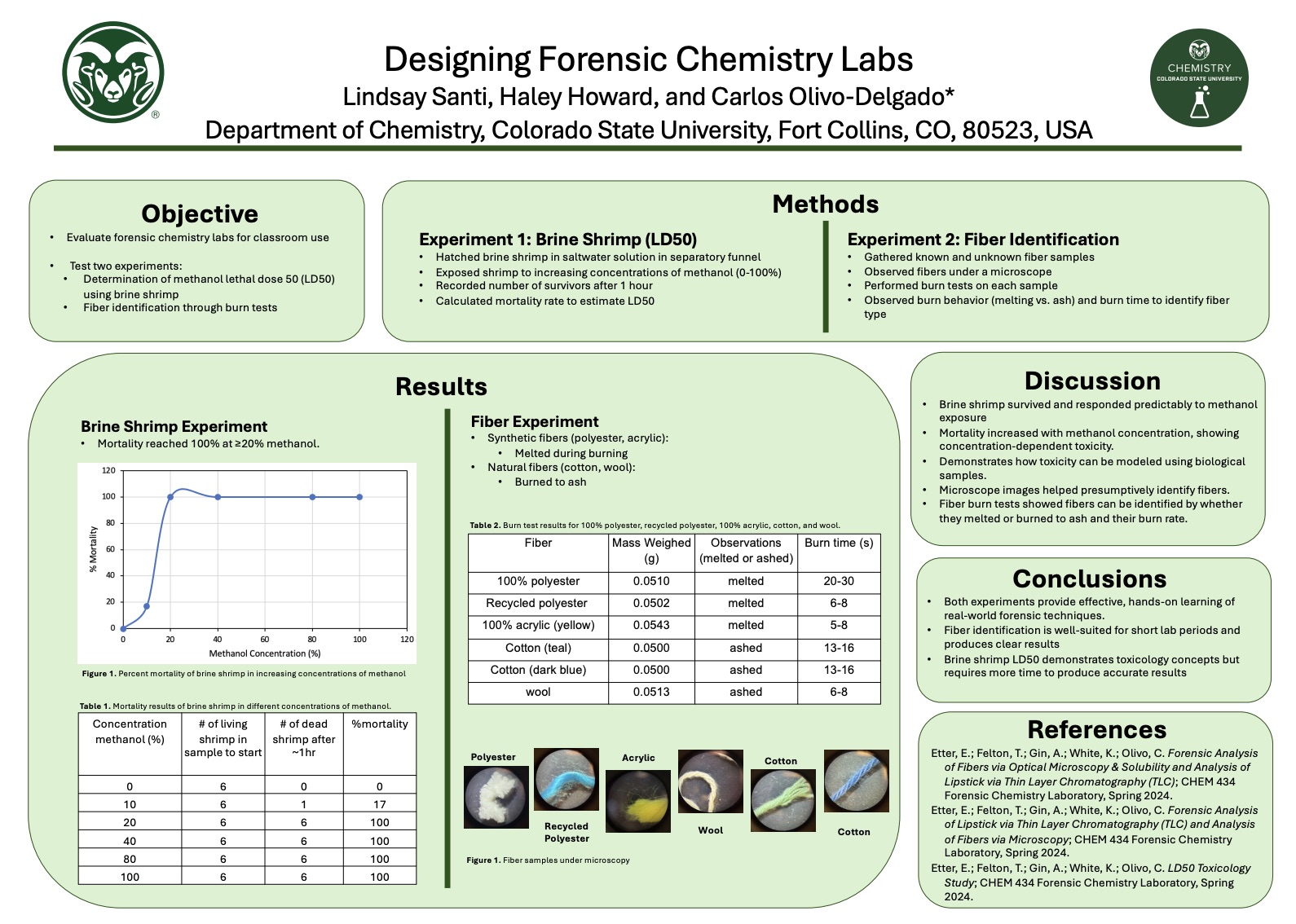
Developing practical forensic laboratory exercises helps students learn evidence analysis techniques. This project evaluated potential forensic chemistry laboratory experiments to use in a recently developed course. Two experiments were tested: one to determine the lethal dose 50 (LD50) of methanol using brine shrimp and another experience about fiber identification . In the brine shrimp experiment, shrimp were exposed to different concentrations of methanol to observe mortality and estimate the LD50 within a three-hour lab period. The brine shrimp were successfully hatched and tested. The mortality of the shrimp increased as the methanol concentration increased, demonstrating the experiment’s usefulness in illustrating toxicological concepts. The fiber experiment used microscopy and a burn test to compare and identify unknown fibers. Identification was based on burn times and whether the fibers produced ash or melted. Natural fibers produced ash, while synthetic fibers melted. Overall, both experiments provide students with useful experience in evidence analysis and can be completed within a three-hour class period. However, the brine shrimp experiment may be less practical because accurate LD50 analysis requires more than three hours of exposure.