
Modeling chronic wasting disease Using Natural and Synthetic Prions
Category: Research Poster
Author(s): Braelyn Maze, Carlos Diaz Dominguez, Zoe Atkinson, Joseph DeFranco, Jenna Crowell, Sehun Kim, Glenn Telling
Presenter(s): Braelyn Maze
Mentors(s): Joseph DeFranco
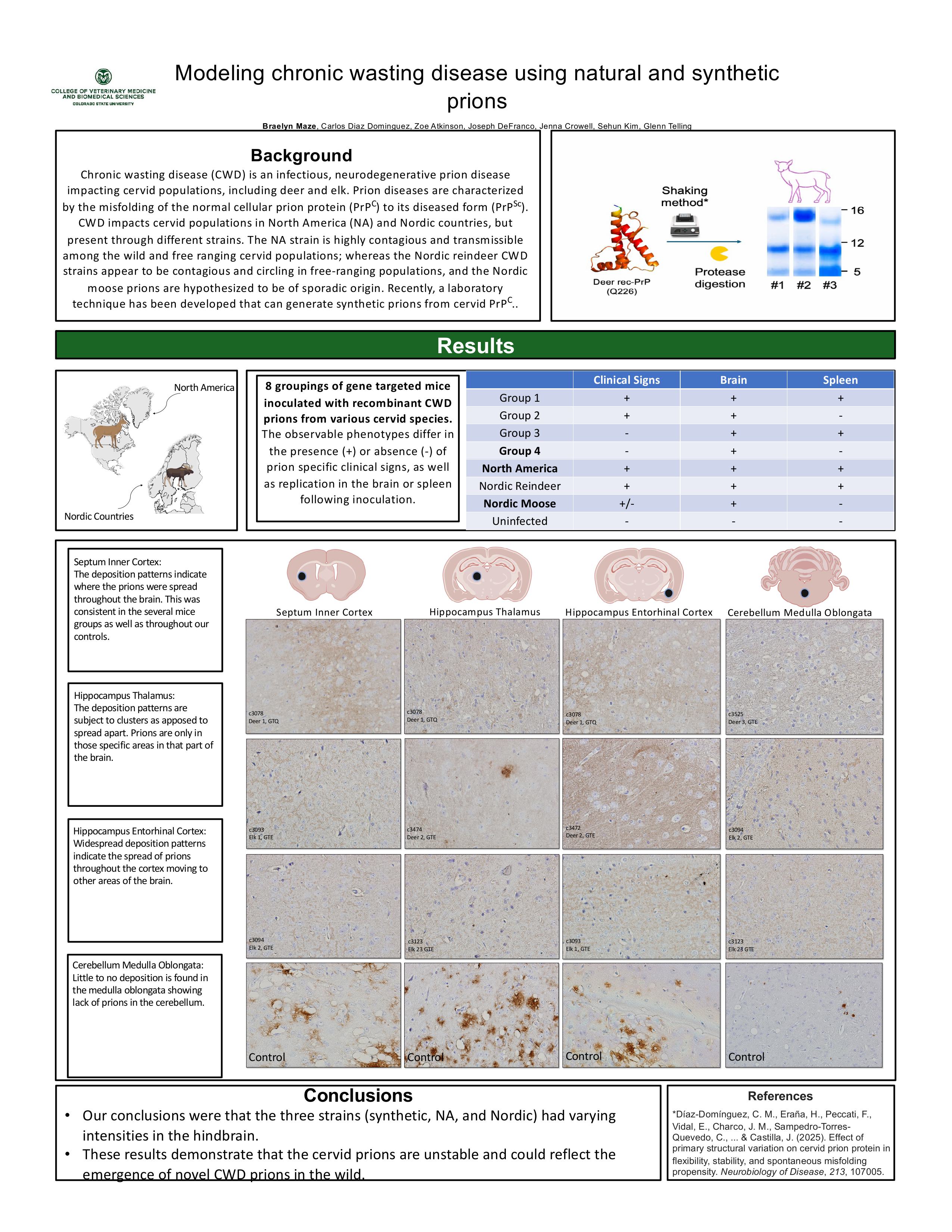
Chronic wasting disease (CWD) is an infectious, neurodegenerative prion disease impacting cervid populations, including deer and elk. Prion diseases are characterized by the misfolding of the normal cellular prion protein (PrPC) to its diseased form (PrPSc). CWD impacts cervid populations in North America (NA) and Nordic countries, but present through different strains. The NA strain is highly contagious and transmissible among the wild and free ranging cervid populations; whereas the Nordic reindeer CWD strains appear to be contagious and circling in free-ranging populations, and the Nordic moose prions are hypothesized to be of sporadic origin. Recently, a laboratory technique has been developed that can generate synthetic prions from cervid PrPC. We hypothesize that transmissions of Nordic moose CWD prions and synthetic cervid prions will produce the same disease outcome. Here, we looked at strains from NA, Norway, and synthetic prions to compare deposition patterns within the brains of gene-targeted mice. Synthetic prions are used to model what could occur in the wild with natural prions, which would provide helpful insight into the strain characteristics of the emerging Nordic CWD strains such as the potential for transmissibility within cervid species and possibly across species such as to humans. Our conclusions were that the three strains (synthetic, NA, and Nordic) had varying intensities in the hindbrain. These results demonstrate that the cervid prions are unstable and could reflect the emergence of novel CWD prions in the wild.