
Mechanisms of Complement Inhibition by Mosquito- and Tick- Borne Orthoflavivirus sNS1 Proteins
Category: Research Poster
Author(s): Analiese Brown
Presenter(s): Analiese Brown
Mentors(s): Imke Steffen, James Terry
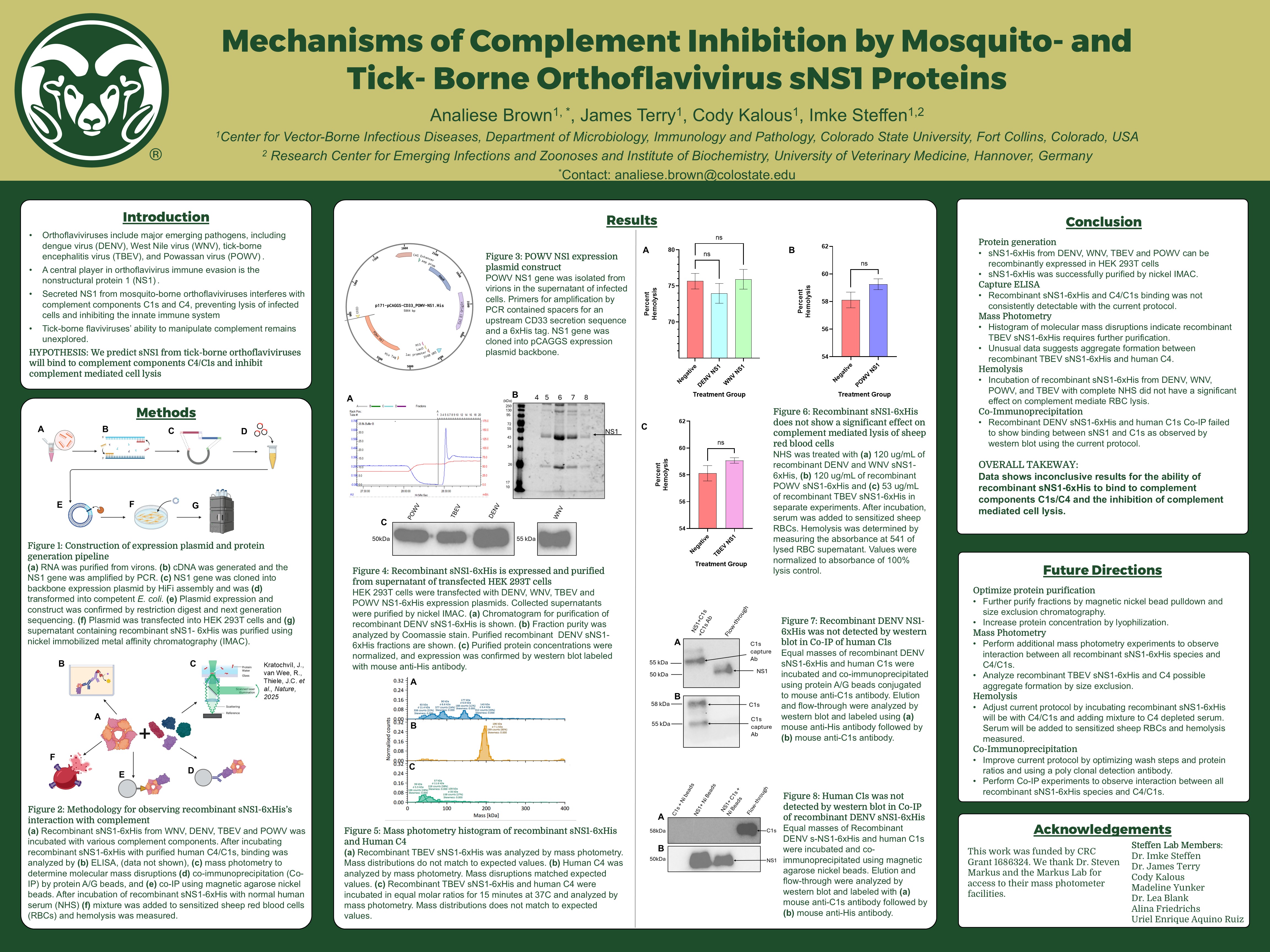
Orthoflaviviruses are vector-borne viruses which include major emerging pathogens such as West Nile virus (WNV), Dengue virus (DENV), tick-borne encephalitis virus (TBEV) and Powassan virus (POWV), all of which pose a significant threat to global health. A central player in Orthoflavivirus infection is non-structural protein 1(NS1), a secreted glycoprotein found in multiple oligomeric forms and suppresses the host immune system through diverse mechanisms. Secreted NS1 (sNS1) from WNV and DENV have been shown to interfere with the complement cascade, particularly through interactions with C1s and C4. These are key proteins in forming the C3 convertase; sNS1’s interaction with C4 and C1s inhibits complement-mediated cell lysis by the membrane attack complex (MAC) and opsonization. Despite the recognized importance of complement inhibition in mosquito-borne Orthoflavivirus infection, the capacity of tick-borne Orthoflaviviruses to manipulate complement remains unexplored. We compared sNS1 proteins from mosquito-borne (WNV, DENV) and tick-borne (TBEV) Orthoflaviviruses for their ability to bind to C1s and C4. We recombinantly expressed and purified WNV, DENV, TBEV and POWV sNS1 from the supernatant of transfected cells. Preliminary results from a binding ELISA found that DENV and WNV sNS1 bound to C1s and C4, consistent with prior studies. Strikingly, we found that TBEV sNS1 bound to C1s and C4. POWV sNS1 will be included in future experiments. Ongoing experiments include co-immunoprecipitation of sNS1 with C1s and C4 and a hemolysis assay to analyze sNS1’s ability to inhibit MAC formation. These findings will expand our understanding of how diverse Orthoflaviviruses exploit sNS1 in immune evasion.