
Developing a Non-Direct Impact, Rotational Traumatic Brain Injury (TBI) Device
Category: Research Poster
Author(s): Benjamin Santangelo, Kelly Santangelo, Katie Sikes, Julie Moreno, Karyn Hamilton
Presenter(s): Benjamin Santangelo
Mentors(s): Maryam Afzali
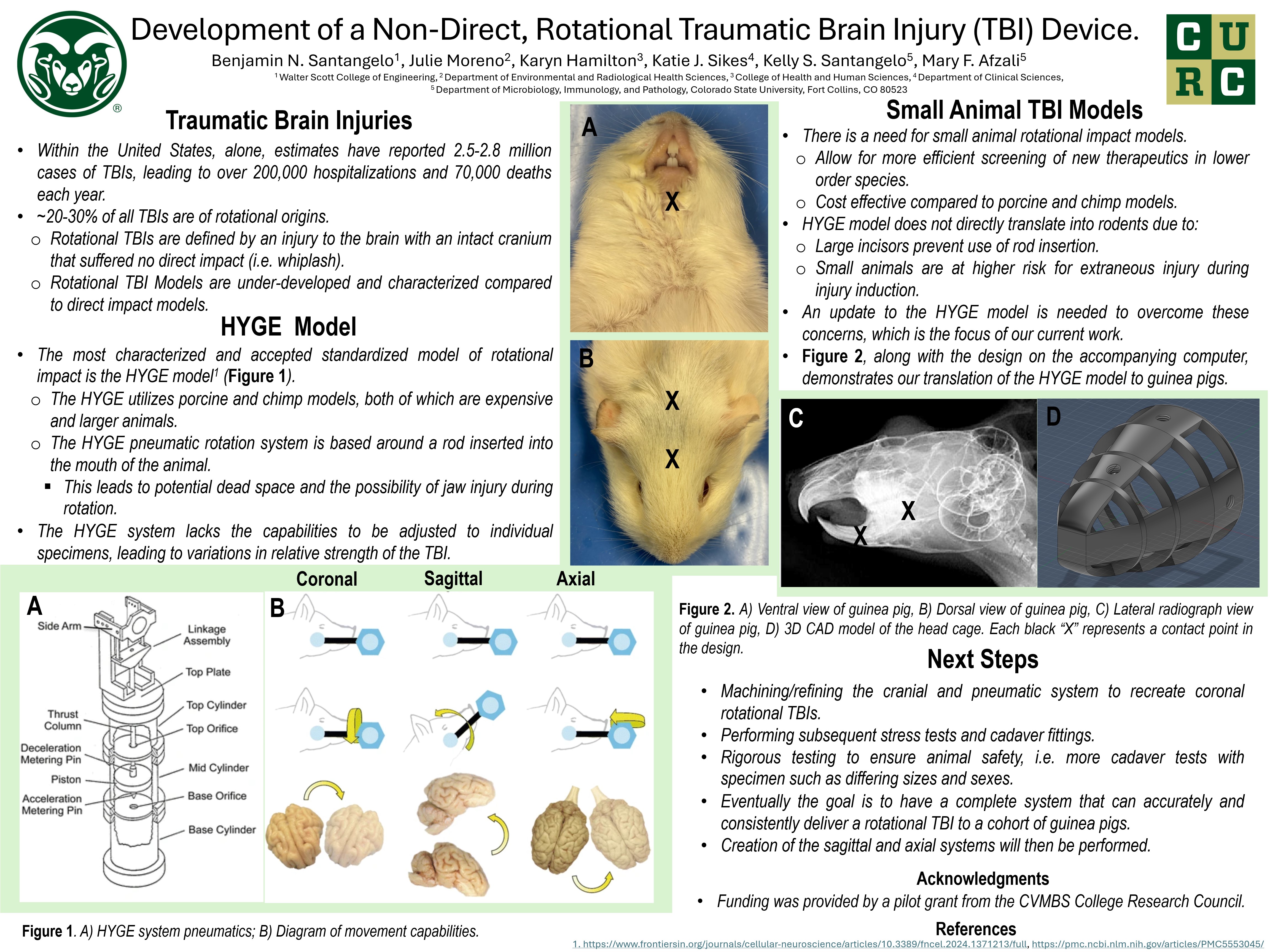
Traumatic brain injuries (TBIs) remain prevalent, with roughly 224,000 cases per year across all ages. TBIs are defined as disturbances in brain function caused by extreme motion resulting in the brain contacting the skull, such as a blow to the head or whiplash. TBIs in animal models are divided into two categories: the direct impact model, which has been characterized in a variety of models, and the rotational model, which is less developed, particularly in small mammals. Notably, however, 25–30% of all TBIs are of rotational origin. Currently, our university lacks a device capable of administering a consistent rotationally based TBI in any species. Therefore, the goal of this project involves understanding the existing methodologies for this form of TBI and designing a device that can deliver a clinically relevant injury to rodents (with a focus on guinea pigs) for the progression of basic and translational research. Current models use high-functioning actuators to induce TBIs in porcine and non-human primate models and scaling these systems down for small mammals will require 3D modeling. The designed system will be compatible with three different rotational models—coronal, sagittal, and axial—to offer the full range of possible injuries. The system will initially be tested via computer modeling and cadaver studies to ensure that the skull and neck of the specimen can withstand the applied trauma. The development of this device will lay the groundwork for future studies and advance the understanding of TBIs through the standardization of an additional experimental model.