
Analysis of Simple Electrical Impedance Tomography Using Conditional Models
Category: Research Poster
Author(s): Jonah Spector, Connor Cassidy, Christian Rayner
Presenter(s): Jonah Spector, Connor Cassidy, Christian Rayner
Mentors(s): Laura Soumastre de Olivera
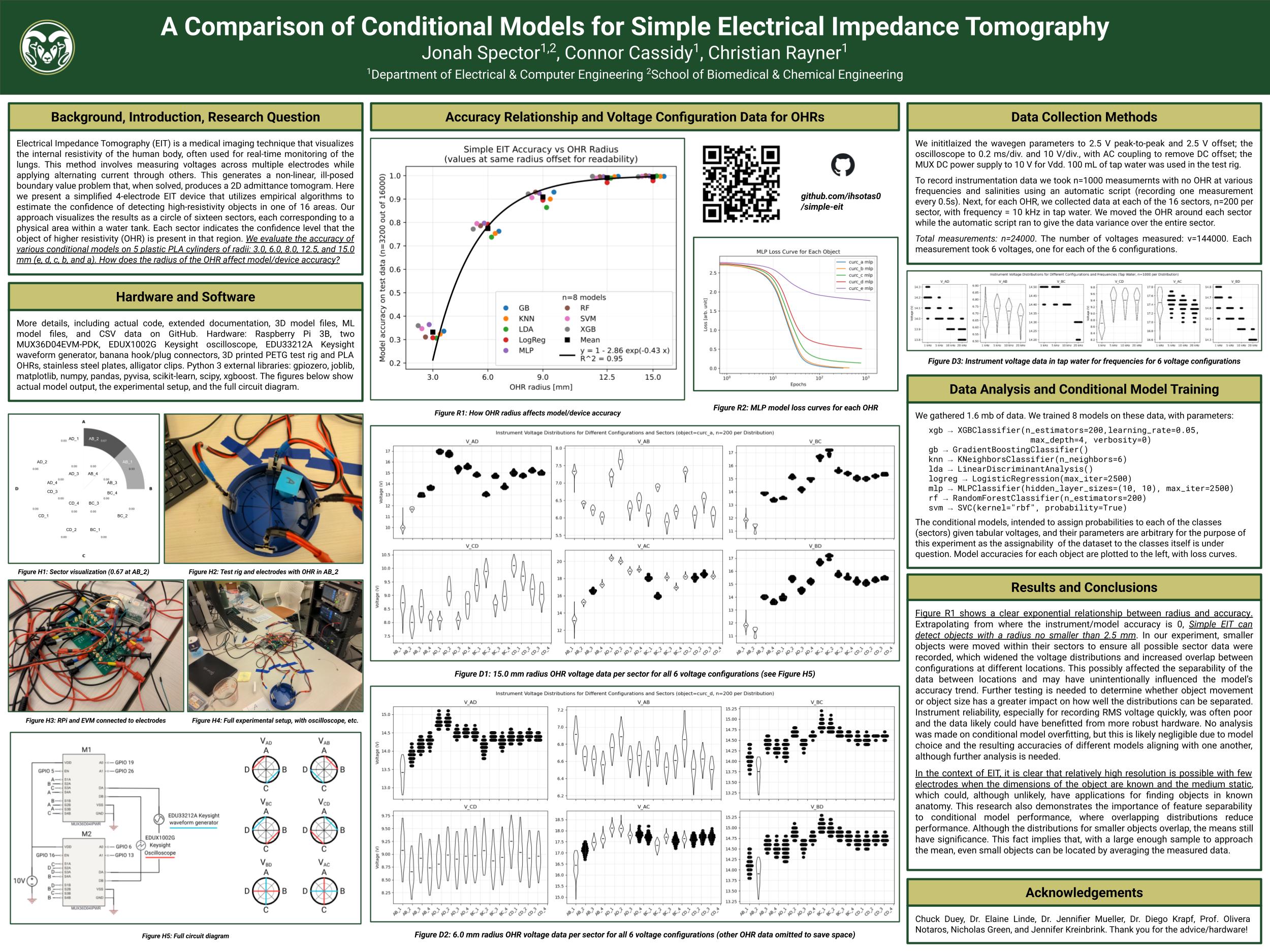
Electrical Impedance Tomography (EIT) is a medical imaging technique that visualizes the internal resistivity of the human body, often used for real-time monitoring of the lungs. This method involves measuring voltages across multiple electrodes while applying alternating current through others. This generates a non-linear, ill-posed boundary value problem that, when solved, produces a 2D admittance tomogram. Here we present a simplified 4-electrode EIT device that utilizes empirical algorithms to estimate the confidence of detecting high-resistivity objects in one of 16 sectors. Our approach visualizes the results as a circle of sixteen sectors, each corresponding to a physical area within a water tank. Each sector indicates the confidence level that the object of higher resistivity (OHR) is present in that region. We evaluate the accuracy of conditional models on 5 plastic PLA cylinders of radii: 3.0, 6.0, 8.0, 12.5, and 15.0 mm (curc_e to a) to determine how the radius of the OHR effects Simple EIT accuracy.