
Variation in group size and canopy height use by primates at Tiputini Biodiversity Station
Category: Research Poster
Author(s): Regan Wasmund, Mark Booth
Presenter(s): Regan Wasmund
Mentors(s): Tanya Dewey
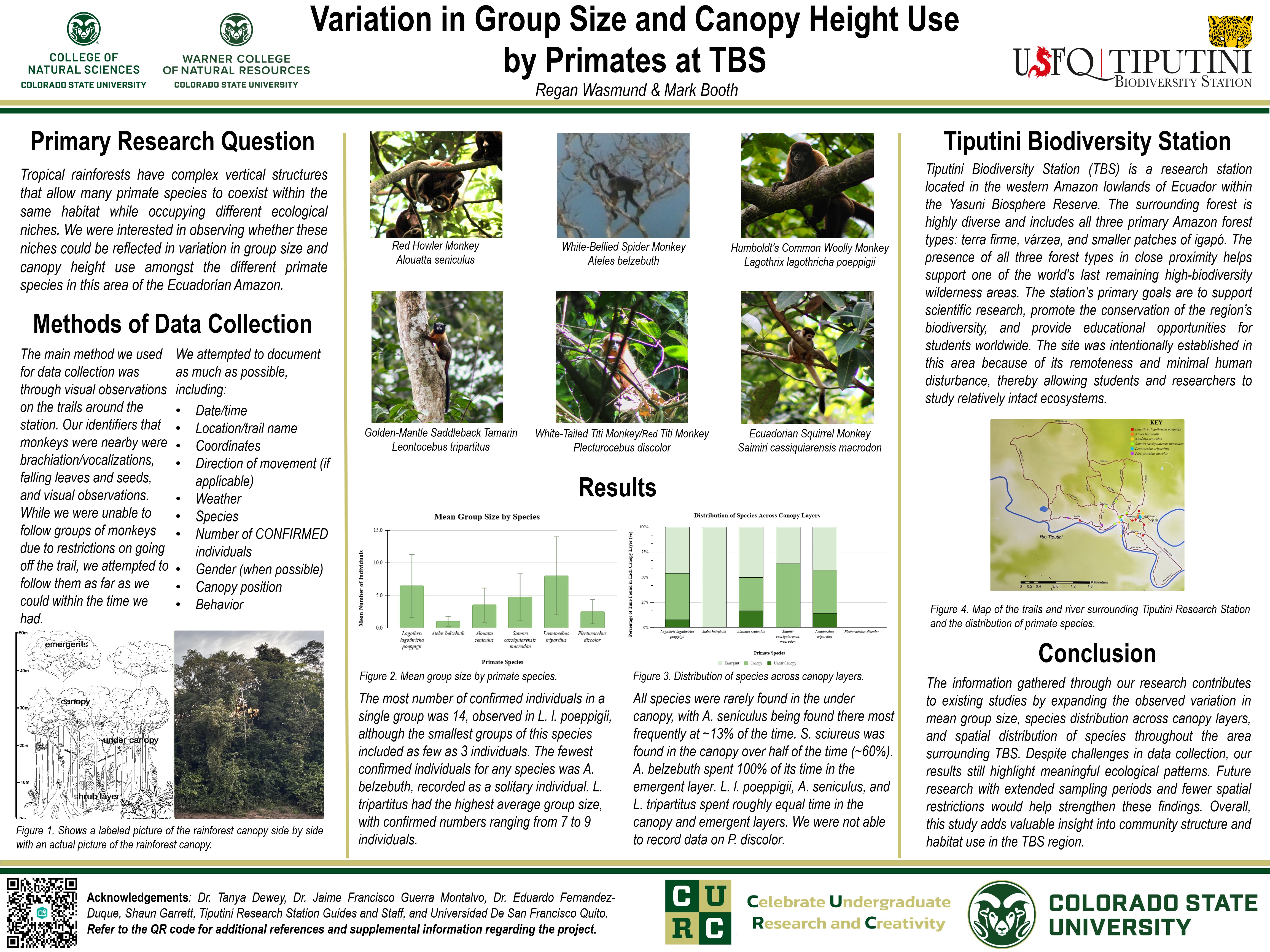
Tropical rainforests have complex vertical structures, including the under canopy, canopy, and emergent layers. These layers allow many primate species to coexist within the same habitat while occupying different ecological niches. It was hypothesized that these niches could be reflected in differences in group size and canopy height use among species. This project examined variation in group size and canopy height use among primates at Tiputini Biodiversity Station in the Ecuadorian Amazon within the Yasuní Biosphere Reserve. Field observations were conducted by following and observing groups and recording species, number of individuals, and approximate canopy height, as well as gender and behaviors when possible. Six different primate species in the area were observed throughout the 7 days. Observations suggested noticeable differences in group size, ranging from a single White-Bellied Spider Monkey to as many as 14 confirmed Humboldt’s Common Woolly Monkeys. Canopy height differences were less pronounced but still present, with White-Bellied Spider Monkeys consistently observed in the emergent layer and Humboldt’s Common Woolly Monkeys and Golden-Mantled Tamarins ranging between the upper canopy and emergent layer. These observations suggest that primate species may use different vertical levels of the rainforest to occupy distinct ecological niches and reduce competition, allowing multiple species to coexist within the same ecosystem.