
Exploring the Role of Eating Disorder Symptoms in the Relation Between Emotion Dysregulation and Engagement in Risky Behaviors
Category: Research Poster
Author(s): Ali Verschueren
Presenter(s): Ali Verschueren
Mentors(s): Bradley Conner
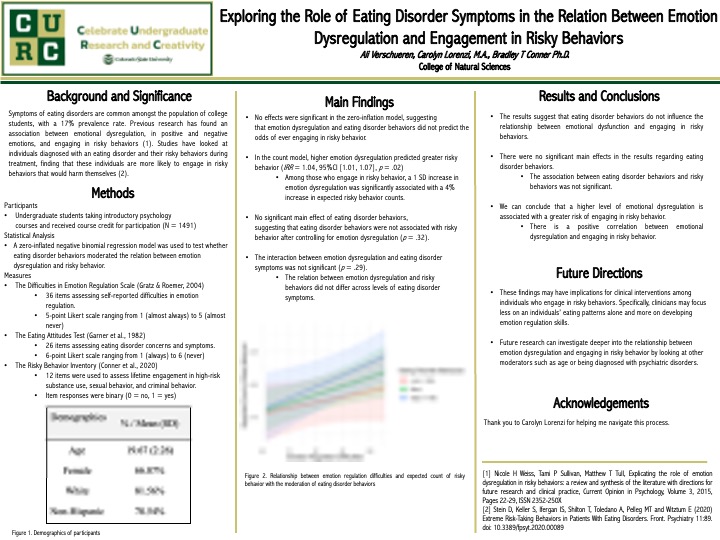
Previous research has found that eating disorders increase the likelihood of engaging in a variety of risky behaviors, such as self-injurious behaviors. Extensive research has also found that individuals who experience greater difficulties in emotion regulation are more likely to engage in risky behaviors. Given that anorexia nervosa has the highest suicide rate among mental disorders, eating disorder symptoms may place individuals with emotion regulation difficulties at greater risk for engaging in maladaptive coping strategies, such as risky behaviors. The present study aims to better understand the role of eating disorder symptoms in the relation between emotion dysregulation and engagement in risky behaviors (e.g., substance use, high-risk sexual behavior). Participants were undergraduate students who completed the Difficulties in Emotion Regulation Scale, Eating Attitudes Test, and Risky Behavior Inventory. A moderated regression analysis will be conducted to test whether eating disorder symptoms influence the strength of the relationship between difficulties in emotional regulation and engagement in risky behaviors. Findings from this study may help inform interventions aimed at reducing risky behaviors.