
How to Catch a Chemical: Novel Analytical Methods to Address Chemotherapy-Induced Cognitive Decline
Category: Research Poster
Author(s): Sophie Kamprath, Dorathea Lee, Romana Jarosova
Presenter(s): Sophie Kamprath
Mentors(s): Romana Jarosova
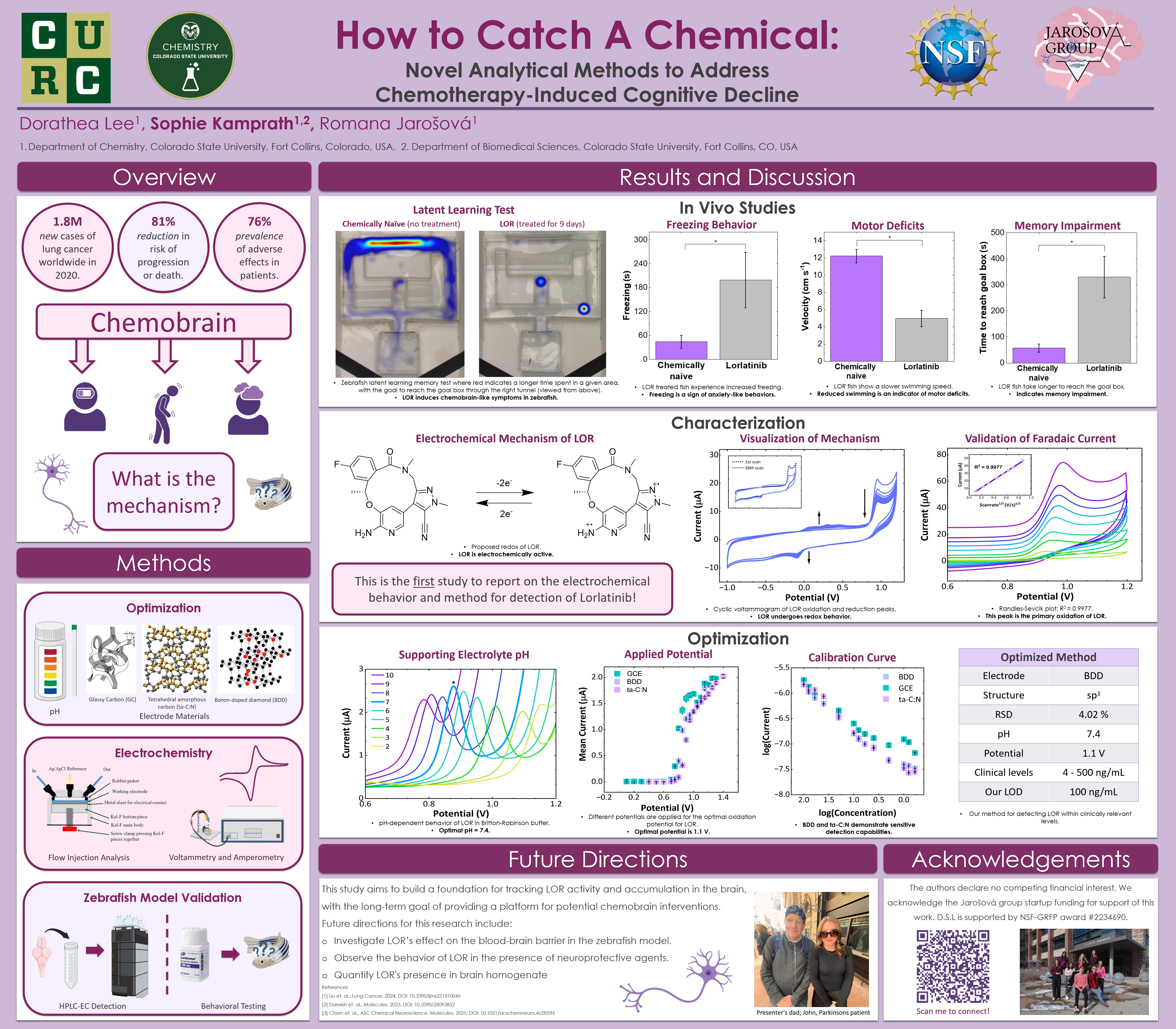
Lorlatinib (LOR) is a newly approved chemotherapeutic that demonstrates unprecedented efficacy. However, over half of patients taking LOR suffer from symptoms of cognitive decline including motor deficits and memory loss. This phenomenon, referred to as “chemobrain”, has a complex and poorly understood mechanism and there is no FDA-approved treatment. Providers are left with limited options and answers, forcing >20% of patients to cease their life-saving chemotherapy. No current framework exists for detection of LOR to facilitate study of this mechanism: until now. We present a sensitive analytical method harnessing high-performance liquid chromatography with electrochemical detection (HPLC-EC) to quantify LOR in situ. These innovative approaches will enable investigation of chemobrain pathology and treatment development. This investigation is the first to report on LOR’s electrochemical behavior and detection. Cyclic and differential pulse voltammetry were utilized to determine the redox mechanism, preferred pH, electrode material, and applied potential. We will discuss the distinct redox mechanism of LOR and our findings on the ideal parameters for quantitation in brain tissue demonstrating the utility of HPLC-ED for rapid, sensitive, and cost-effective analysis. This work strives to benefit not only the translational research community but also progress towards a solution for the millions of chemobrain sufferers worldwide.