
Evaluating the Impact of Public Knowledge and Messaging on West Nile Virus Protective Behaviors and Insecticide Support
Category: Research Poster
Author(s): Juliette Dashe, Nicole Kelp-Sullivan, Amanda McGill, Jackson DeCook, Kaylie Kwan, Foram Raval, Layla Steinbock
Presenter(s): Juliette Dashe
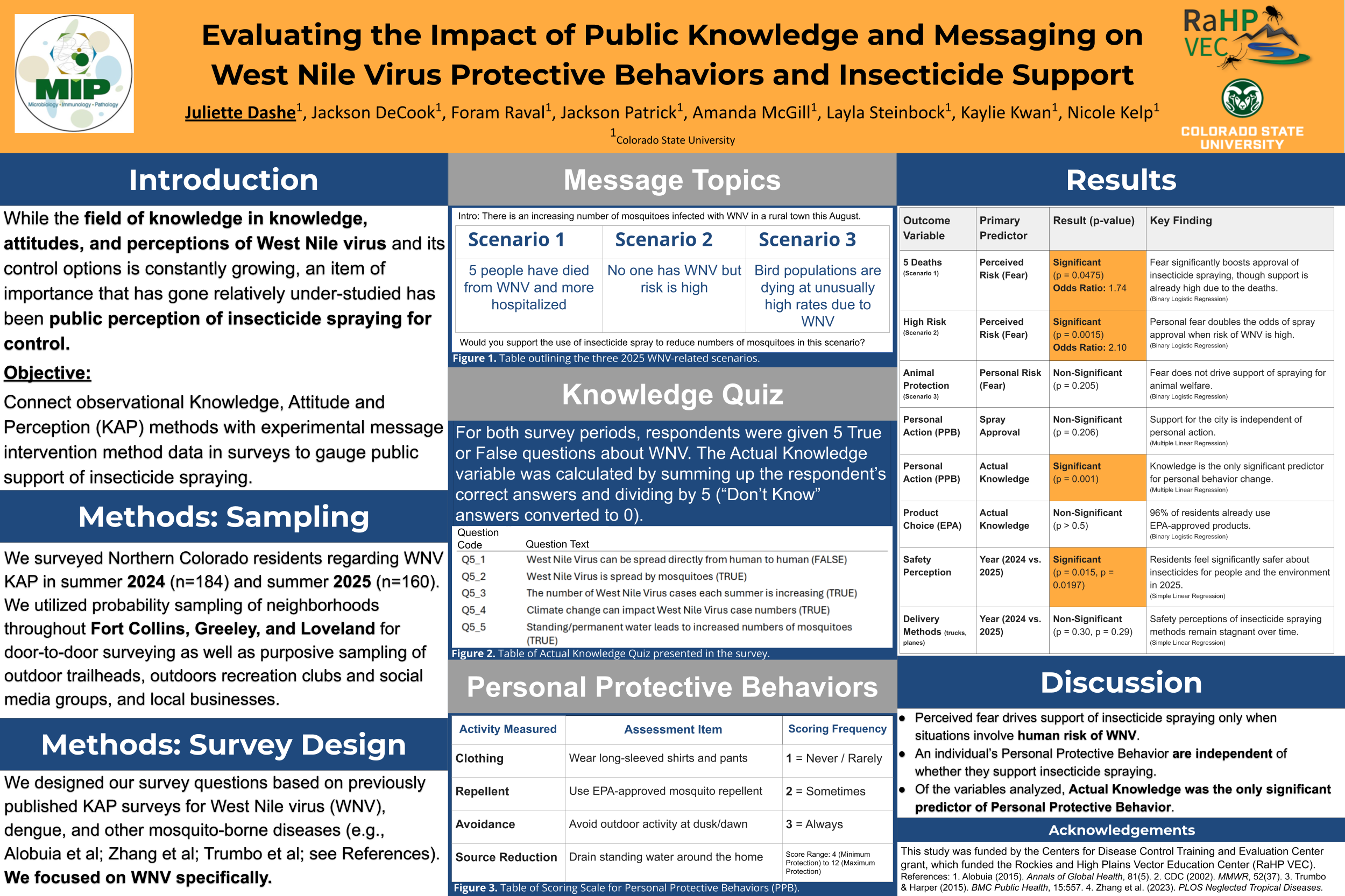
The sustained presence of West Nile Virus (WNV) in Front Range communities necessitates effective public health strategies to encourage personal protection and support vector control. This study utilized two cross-sectional Knowledge, Attitude, and Practice (KAP) surveys conducted in 2024 (N=167) and 2025 (N=136) to compare public response and identify predictors of protective behavior. Data analysis, utilizing two-sample t-tests, revealed no statistically significant change between the two years in either objective knowledge of WNV transmission (Mean Score): 4.73/5 4.74/5; p=0.9159) or perceived susceptibility (personal risk/worry; p=0.1051). A Multiple Linear Regression (MLR) model predicting Personal Protective Behavior (PPB) Scores (range 4–12) found that Actual Knowledge was the strongest and only significant psychological predictor of action (β=0.343, p<0.001), while neither perceived susceptibility nor perceived severity significantly motivated PPB (p>0.48). The MLR also showed that PPB usage was significantly higher in the 2025 group (β=0.364, p=0.038), indicating a notable year-over-year increase in community vigilance. An experimental message test comparing four distinct message types on support for insecticide spraying (pre- vs. post-message) found no statistically significant difference in the ability of any single message to shift public opinion (Chi-Squared p=0.34). This research suggests that helping community members better understand WNV may help contribute to personal protective behaviors. Furthermore, the small, observed shifts in support suggest that the messages tested did not significantly overcome existing baseline attitudes toward vector control.