
Beyond the Home: Foster Care Experiences
Category: Research Poster
Author(s): Ashlyn Murray, Trinity Yamagata, Isabel Pineda, Tea Benzenberg
Presenter(s): Ashlyn Murray
Mentors(s): Janelle Viera
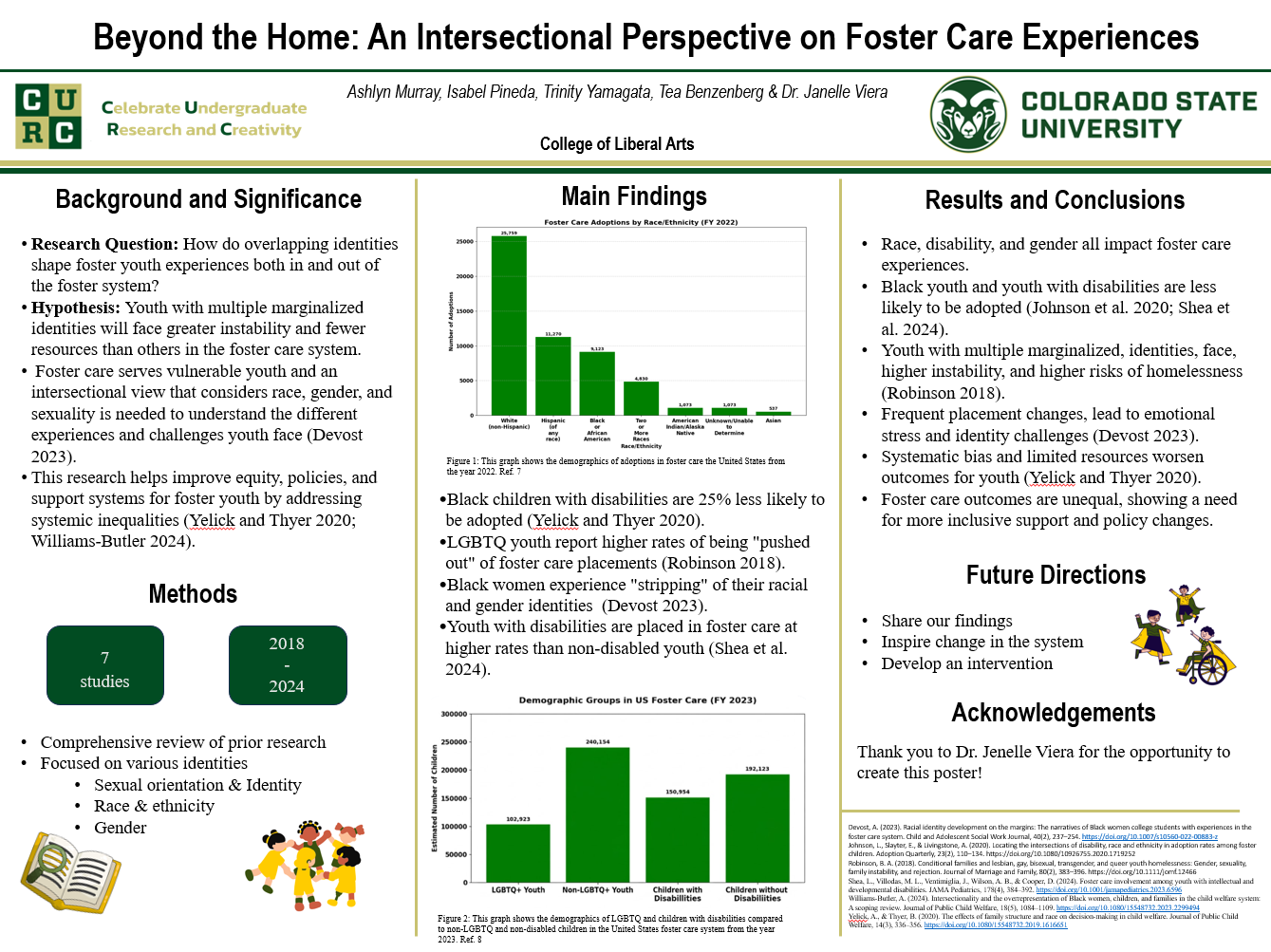
Abstract In the United States, the majority of foster parent families are white, married women over the age of 30. In contrast kids in foster care come from various diverse backgrounds with Black and American Indian and Alaska Native children continuing to be overrepresented. This leaves little room for diversity in race, gender, and social class to be represented in a huge federal system. This study highlights the importance of intersectionality and how race, gender, and class shape the foster care experience. Our research highlights how systematic inequalities extend far beyond a child's experience. Systematic inequalities in the foster care system reach into the idea of the placement process, access to resources for children in foster care, the role of children's identities and disabilities affecting their foster care placement process and journey. This topic is important to address the inequalities that children in the foster system face due to their intersectional identities. We chose to present this information in poster format to fully illustrate the disparities across various identities. We want to show clear statistics and past research that illustrate these systematic inequalities. By centering the lived experiences of marginalized youth, the research highlights the ways social identities create challenges for all of those involved in the foster care system. Furthermore, this research also highlights the intersectional framework in policies and institutional systems.