
Pavlovian Biases Under Time Constraints
Category: Research Poster
Author(s): John Poturalski, Madisyn Herron
Presenter(s): John Poturalski
Mentors(s): Sanjiti Sharma, Carol Seger
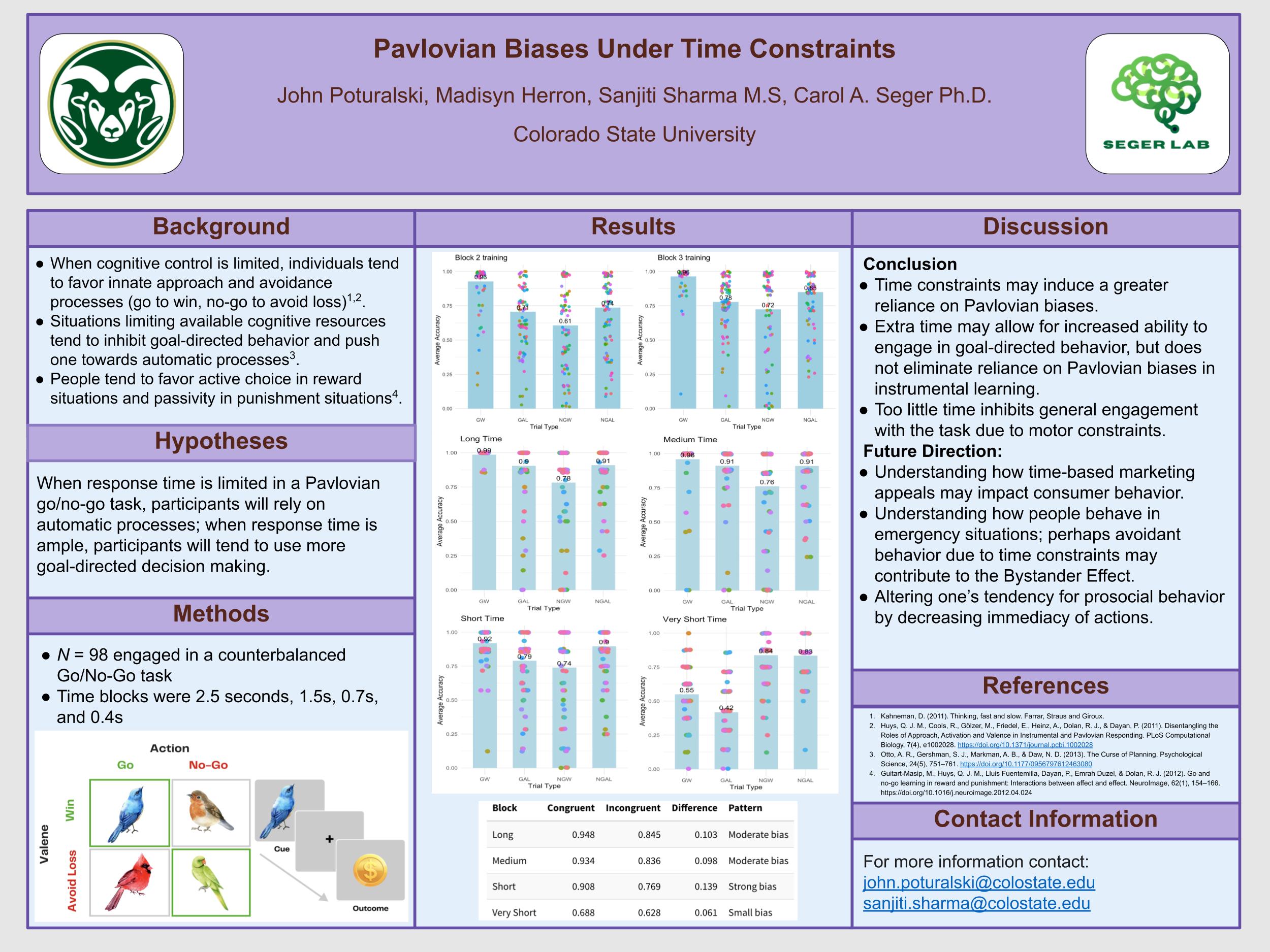
Pavlovian biases are unconscious decision-making mechanisms that operate in response to rewards (approach)/punishments (avoid); however, these biases are often suboptimal, as the correct response may be in conflict with one’s innate bias. For example, a participant may be required to go (approach) to avoid punishment, which is conflicting. This study investigates whether participants rely more on Pavlovian biases under time constraints; as time decreases, participants will utilize the automatic biases because they use fewer cognitive resources. Using a Go/No-Go task, we applied time pressure ranging from long to very short, in which participants were asked to determine the optimal response to previously learned stimuli. We hypothesized that participants would rely on Pavlovian biases rather than instrumental learning when faced with time constraints. This study found that, in alignment with our hypothesis, in longer conditions, participants relied on goal-directed responses, whereas as time decreased, they relied more on Pavlovian biases. In the long and medium conditions, participants utilized their time to choose the correct response, demonstrating goal-directed instrumental learning. In the very short condition, participants demonstrated reliance on Pavlovian biases rather than instrumental learning. The very short condition revealed a motor constraint floor; our data showed a dramatic decrease in success on any stimulus that required participants to act, likely because they could not physically respond in time. Our study illustrates a tendency towards Pavlovian biases under time-constrained conditions, which could have applied implications in contexts where individuals must make high-stakes choices in time-constrained situations (emergencies, for example).