
Determining the Efficacy of Existing Elephant Rumble Identification Models
Category: Research Poster
Author(s): Ben DuMais
Presenter(s): Ben DuMais
Mentors(s): George Wittemyer, Jesse Turner
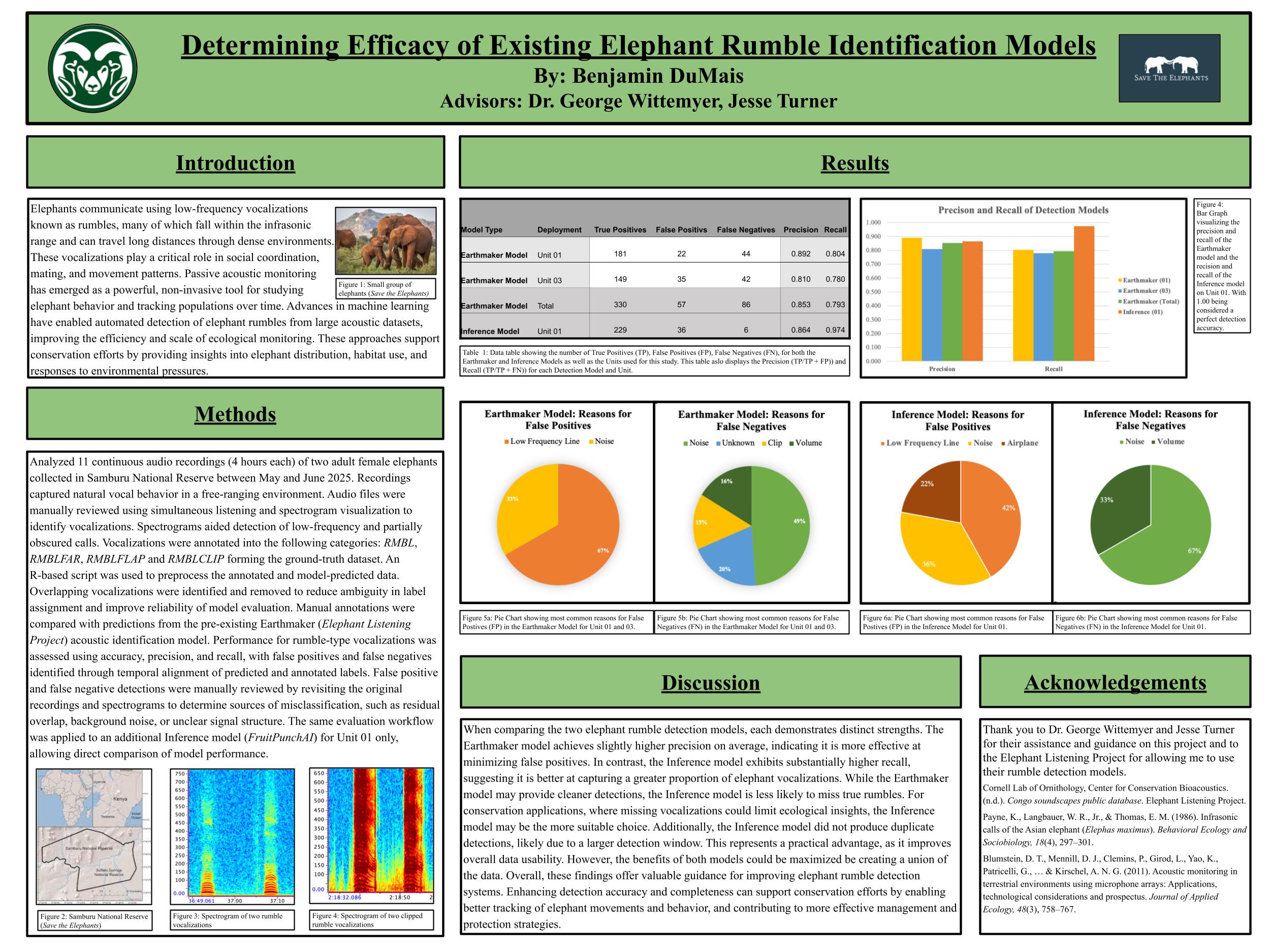
Passive acoustic monitoring has become an increasingly important tool for studying and conserving African elephants, particularly for detecting and analyzing low-frequency rumble vocalizations that play a central role in elephant communication. Automated rumble identification models have been developed to assist with large-scale acoustic analyses, but their effectiveness can vary across datasets and individuals. This study evaluates the efficacy of existing elephant rumble identification models using acoustic recordings of three adult African elephants (two females and one male) from Samburu National Reserve, Kenya. Audio recordings were manually reviewed and annotated using Raven Pro software, with particular focus on identifying rumble vocalizations. These annotations served as the ground-truth dataset. Model detections generated by previously developed rumble identification algorithms were then compared to the manual annotations. A custom script was used to calculate precision and recall, defining a true positive as any instance where a model detection temporally overlapped with a manually annotated rumble event. False positives and false negatives were identified accordingly. Performance metrics were calculated both for each individual elephant and across the combined dataset. The results provide insight into the strengths and limitations of current elephant rumble identification models and highlight considerations for improving automated acoustic monitoring of elephant communication. These findings contribute to the development of more accurate bioacoustics tools for wildlife research and conservation.