
“Association Between Inter-Limb Asymmetry and Countermovement Jump Height”
Category: Research Poster
Author(s): Eric Brown
Presenter(s): Eric Brown
Mentors(s): Christopher Patrick
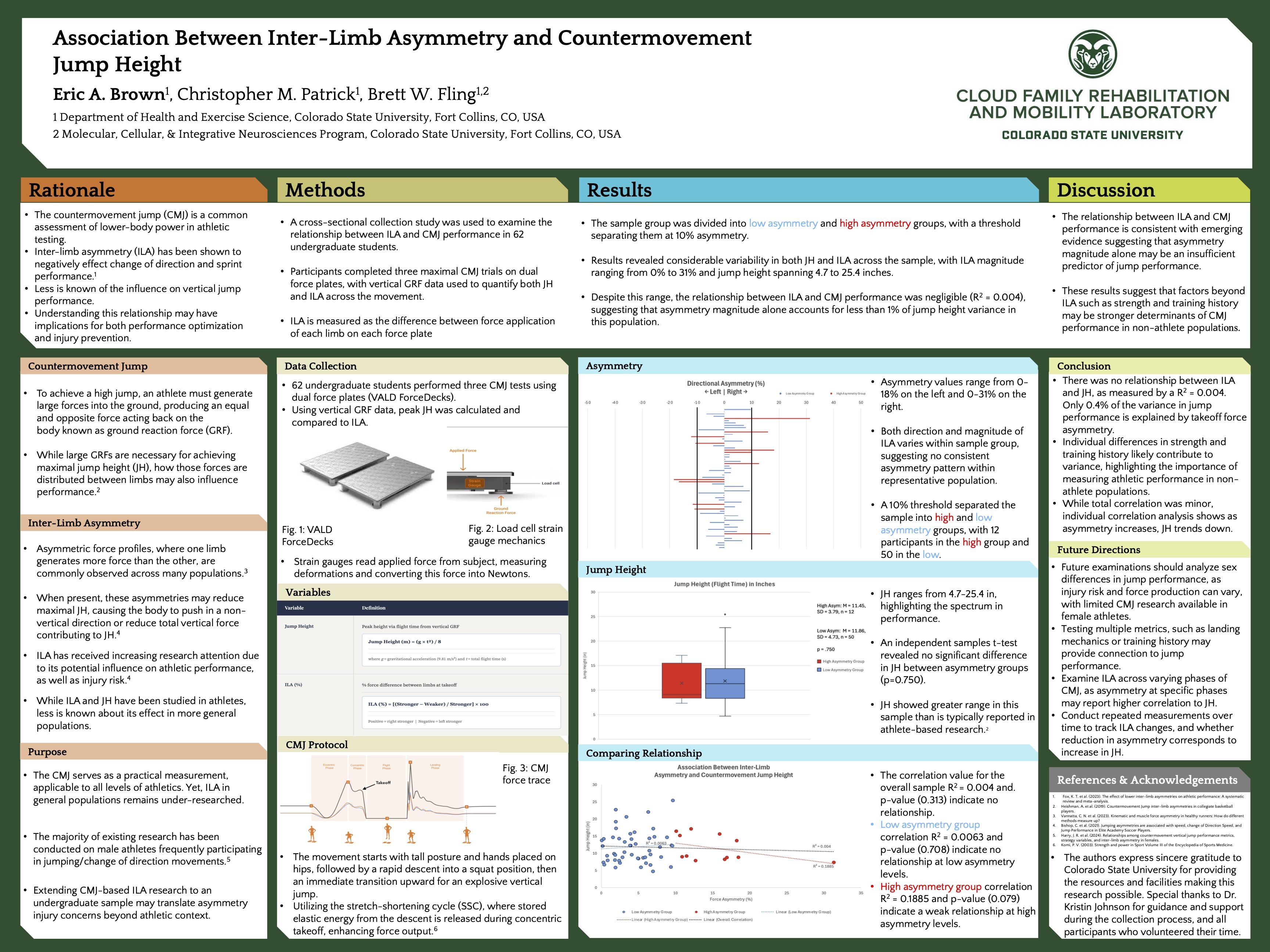
The countermovement jump (CMJ) is a commonly used assessment in athletic testing to measure lower-body power. The movement starts with tall posture and hands placed on hips, followed by a rapid descent into a squat position, then an immediate transition upward for an explosive vertical jump. To achieve a high jump, an athlete must generate large forces into the ground, which produces an equal and opposite force acting back on the body known as ground reaction force (GRF). While large GRFs are necessary for achieving maximal jump height (JH), how those forces are distributed between the limbs during a bilateral task such as the CMJ may also influence performance. Asymmetric force profiles, where one limb generates more force than the other, are commonly observed across many populations. When present, these asymmetries may reduce maximal JH, causing the body to push in a non-vertical direction or reducing total vertical force contributing to JH. Inter-limb asymmetry (ILA) has received increasing research attention due to its potential influence on athletic performance, as well as injury risk. While ILA and JH have been studied in athletes, less is known about its effect in more general populations. In this study, 62 undergraduate students performed three CMJ tests using force plates (VALD ForceDecks), a specialized platform equipped with four strain-gauge load cells to quantify vertical GRF. Using vertical GRF data, peak JH was calculated and compared to ILA, quantified as the percentage difference in force production between limbs at different phases of the jump.