
Does Family Income Correlate with Children's Language Environments?
Category: Research Poster
Author(s): Zoe Koch, Ashlyn Murray, Morgan Stuart
Presenter(s): Zoe Koch, Ashlyn Murray, Morgan Stuart
Mentors(s): Daniela Alvarez-Vargas, Robert Duncan
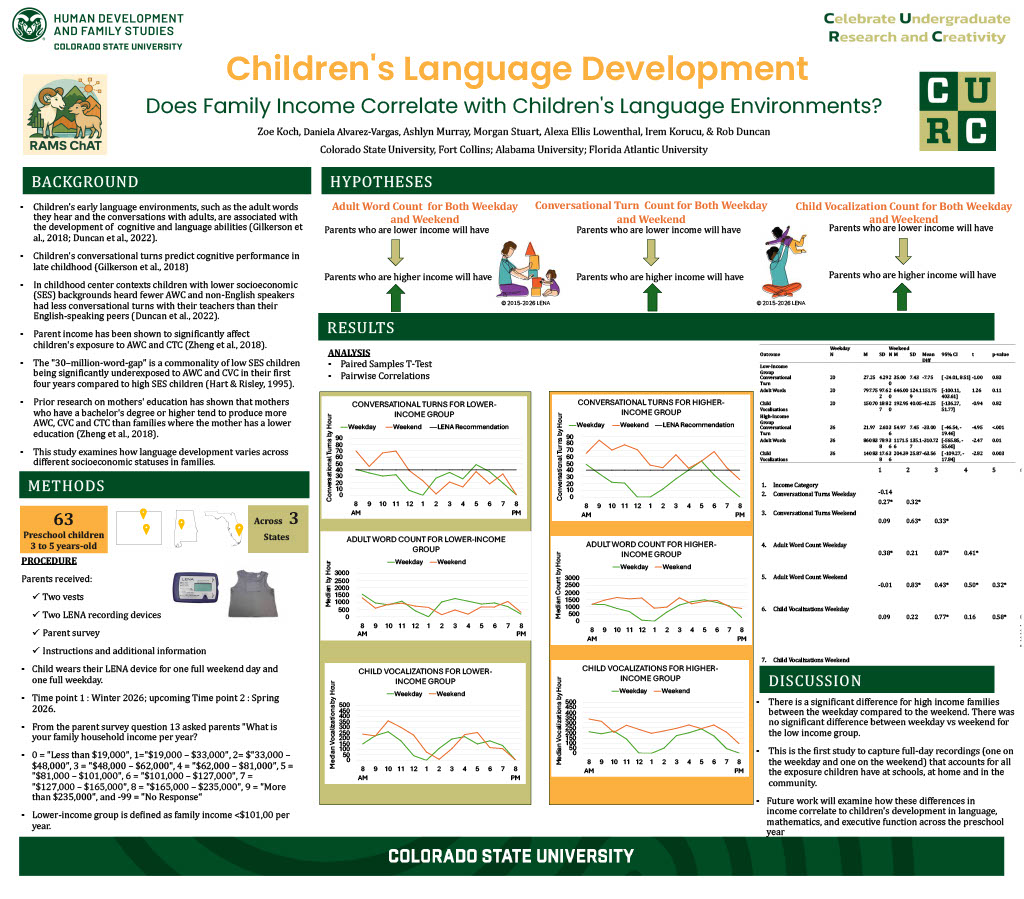
Children's exposure to language and vocabulary has been positively associated with their ability to learn and develop specific language, mathematic and executive functioning skills (Anderson et al., 2025; Gilkerson et al., 2018). The study that we are actively conducting is focused on the difference of Conversational Turn Counts (CTC) and Adult Word Counts (AWC) that are observed during the weekday compared to the weekend day for preschoolers. We are using the data collected from the audio recording devices the Language Environment Analysis (LENA) and parent surveys to find the association between parent income and children's exposure to CTC’s and AWC’s. Multiple studies have shown that parents who have higher education and higher socioeconomic status (SES) tend to interact more with their children and have higher counts of Conversational Turns (CTC) and Adult Word Counts (AWC) (Zheng et al., 2025). Previous work has shown that children from families with higher income experience preschool language environments with higher AWC and CTC (Duncan et al., 2022). This work is imperative for the 72% of children living in poverty, these children spend about equal amounts of time in the classroom as they do at home (de Brey & Donaldson, 2018). The goal of this study is to understand how family income correlates to the language experiences children encounter in the home and at preschool. We hope to determine if there are differences in language affordances for low-income children and if they receive different supports in the home or in the school.