
Early circuit development at the cerebellar cortico-nuclear synapse
Category: Research Poster
Author(s): Evan Harris, Raven McGann, Christopher Vaaga
Presenter(s): Evan Harris
Mentors(s): Christopher Vaaga
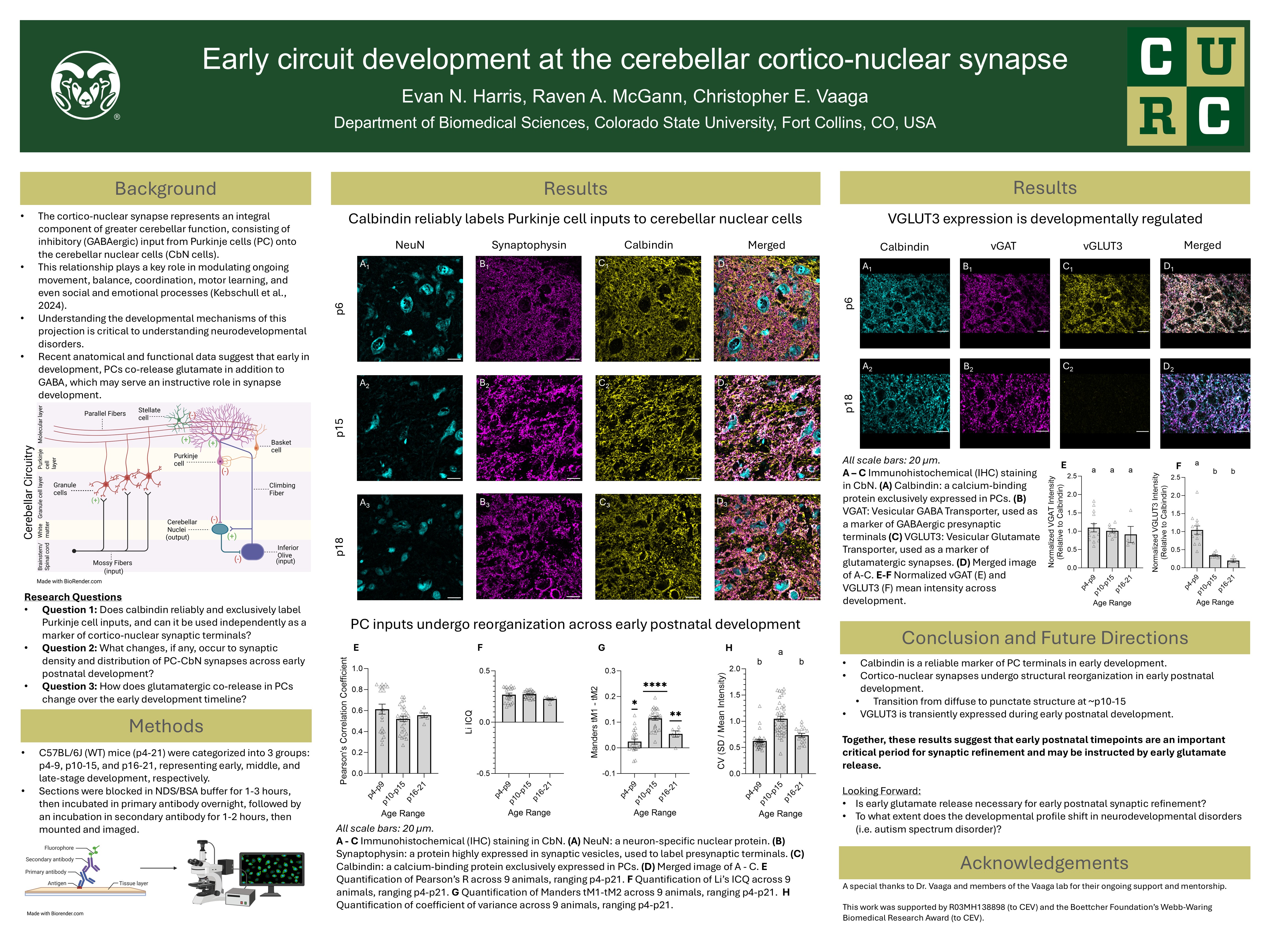
The cerebellum has traditionally been viewed as a motor structure, but recent evidence suggests that it may play a significant role in emotion, autonomic, and cognitive function. These new developments highlight an emerging need to understand early circuit development within the cerebellum, as disruptions may contribute to neurodevelopmental disorders, such as autism spectrum disorder (ASD). At the circuit level, Purkinje cells (Pkj cells) provide the sole output of the cerebellar cortex, synapsing onto neurons in the cerebellar nuclei (CbN). In adult tissue, the cortico-nuclear synapse (Pkj cell to CbN cell) is strongly inhibitory (GABAergic), but recent anatomical and functional data suggest that early in postnatal development, Pkj cells also co-release an excitatory neurotransmitter (glutamate). In many inhibitory circuits, developmental glutamate release plays an important role in early synaptogenesis. Here, we sought to elucidate the synaptic development of the cortico-nuclear synapse using immunohistochemical approaches. First, we quantified the density of Pkj cell synaptic terminals within the cerebellar nuclei across development by co-staining for calbindin (a Pkj cell-specific marker) and synaptophysin (a presynaptic terminal marker). We next sought to characterize developing synapses as glutamatergic or GABAergic using antibodies against cell-type specific presynaptic proteins (GABA: vGAT; Glutamate: vGLUT3). These results will define the synaptic development of both glutamatergic and GABAergic synapses at the cortico-nuclear synapse; laying a foundation to understand how neurodevelopmental disorders may disrupt early cerebellar circuit formation.