
The Effects of Pavlovian Biases on Instrumental Learning and Behavior
Category: Research Poster
Author(s): Madisyn Herron, John Poturalski
Presenter(s): Madisyn Herron
Mentors(s): Carol Seger, Sanjiti Sharma
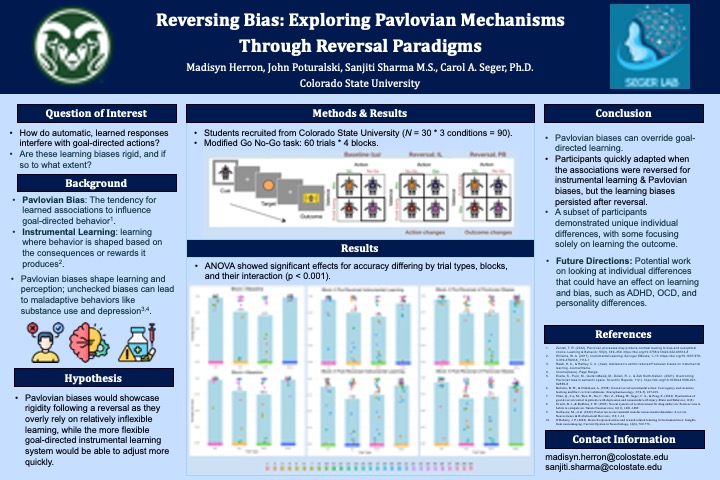
Our decision-making processes are often shaped by Pavlovian Biases, however these responses have traditionally been understood as suboptimal in new and dynamic environments. These biases may lead to actions that can hinder an individual's ability to adjust to situations which can ultimately lead to suboptimal decisions leading to maladaptive behaviors. This study uses task reversal in order to explore the interaction between these biases and goal-directed learning. We hypothesized that Pavlovian biases would showcase rigidity following a reversal as they overly rely on relatively inflexible learning, while the more flexible goal-directed instrumental learning system would be able to adjust more quickly. The experimental design used a Go No-Go task, consisting of two phases: a replication of existing findings from Raab and Hartley (2020), followed by a task reversal paradigm to assess cognitive flexibility. The results indicated that instrumental learning showcased flexibility, as participants were able to successfully adjust their behavior after the reversal. In contrast, Pavlovian biases, or inflexible learning, caused a decrease in accuracy following the reversal followed by a slow adaptation, especially when conflict with instrumental goals arose. These results highlight the relatively rigid nature of Pavlovian biases, especially during reversal and their negative impact on decision-making and cognitive flexibility.Our decision-making processes are often shaped by Pavlovian Biases, however these responses have traditionally been understood as suboptimal in new and dynamic environments. These biases may lead to actions that can hinder an individual's ability to adjust to situations which can ultimately lead to suboptimal decisions leading to maladaptive behaviors. This study uses task reversal in order to explore the interaction between these biases and goal-directed learning. We hypothesized that Pavlovian biases would showcase rigidity following a reversal as they overly rely on relatively inflexible learning, while the more flexible goal-directed instrumental learning system would be able to adjust more quickly. The experimental design used a Go No-Go task, consisting of two phases: a replication of existing findings from Raab and Hartley (2020), followed by a task reversal paradigm to assess cognitive flexibility. The results indicated that instrumental learning showcased flexibility, as participants were able to successfully adjust their behavior after the reversal. In contrast, Pavlovian biases, or inflexible learning, caused a decrease in accuracy following the reversal followed by a slow adaptation, especially when conflict with instrumental goals arose. These results highlight the relatively rigid nature of Pavlovian biases, especially during reversal and their negative impact on decision-making and cognitive flexibility.