
Improved cell culture model for prion disease using chimeric N- and C-terminal signal peptides
Category: Research Poster
Author(s): Nosiba Boukhris, Xutong Shi, Hannah Bodrogi, Glenn Telling
Presenter(s): Nosiba Boukhris
Mentors(s): Joseph DeFranco
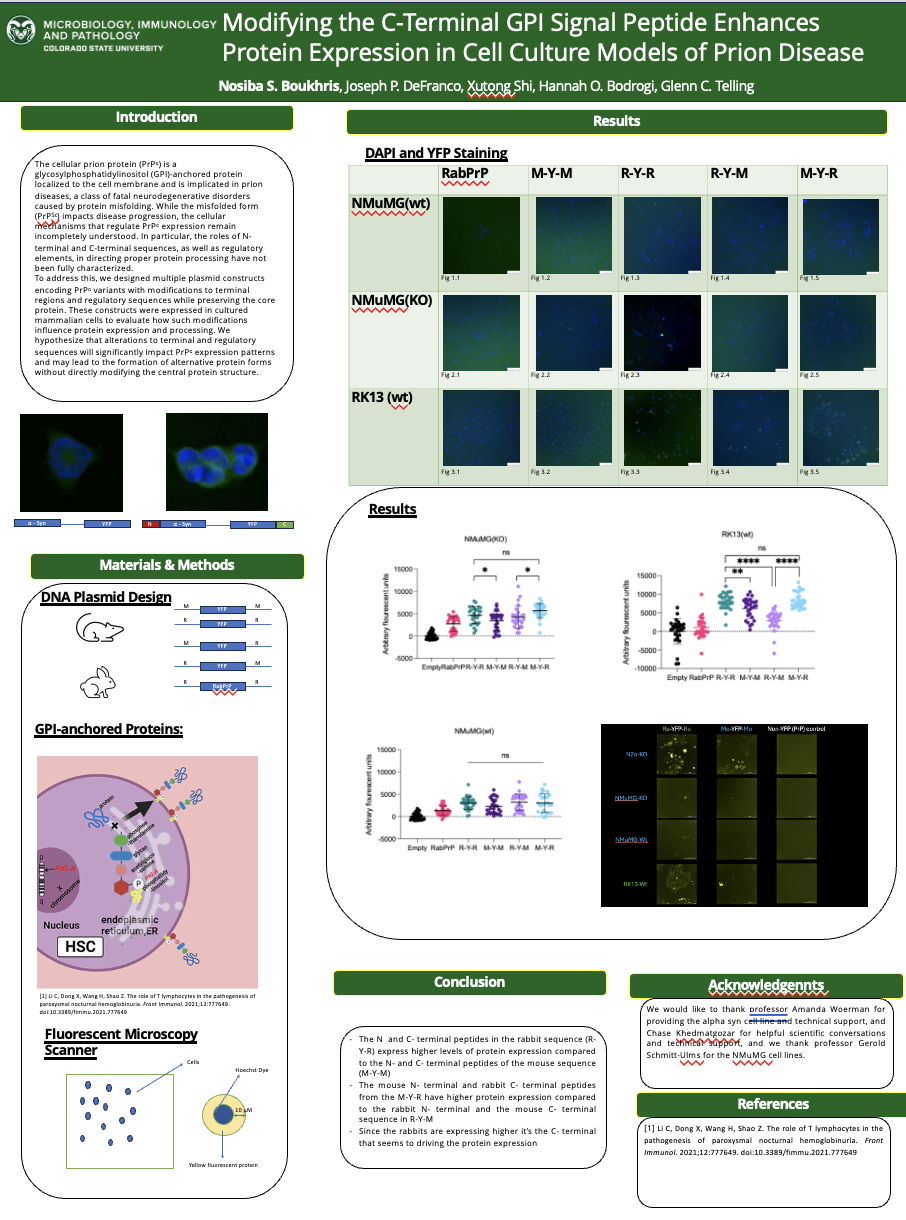
Neurodegenerative disorders, such as Alzheimer’s disease and Parkinson’s disease, involve the misfolding of a host-encoded protein into a misfolded state. For instance, prion disorders involve the conformational change of the cellular prion protein (PrPC) to the disease-associated isoform, PrPSc. The majority of neurodegenerative diseases, including prion disorders, are invariably fatal and lack effective therapeutics. One of the reasons that therapeutic strategies fail in clinical trial phases is due to the lack of models that effectively reproduce disease mechanisms. Numerous studies have demonstrated that elevated levels of PrPC can enhance PrPSc replication. This research aims to increase the expression of PrPC in cell culture to develop better disease models. PrPC is a protein that is expressed on the cell membrane and attached by a glycosylphosphatidylinositol (GPI) anchor, which is programmed by the N- and C-terminal signal sequences. To investigate how modifications to N- and C-terminal sequences can influence PrPC expression, we designed expression plasmids to encode for the yellow fluorescent protein (YFP) with the PrPC N- and C-terminal signal peptide sequences (N-YFP-C). We used these plasmids to generate mammalian cell lines that expressed chimeric N-YFP-C proteins. To evaluate the effects of different N- and C-terminal signal peptide sequences, we analyzed protein expression through western blotting and cell microscopy. We show that protein expression is dictated by different N- and C-terminal signal peptide sequences, which suggests that there are aspects of the non-mature protein that impact expression levels. These findings have implications for developing improved models for neurodegenerative disease research.