
Estimating Nitrogen Mineralization Potentials of Organic Versus Mineral Dominated Soils
Category: Research Poster
Author(s): Kate Kleist
Presenter(s): Kate Kleist
Mentors(s): Meagan Schipanski
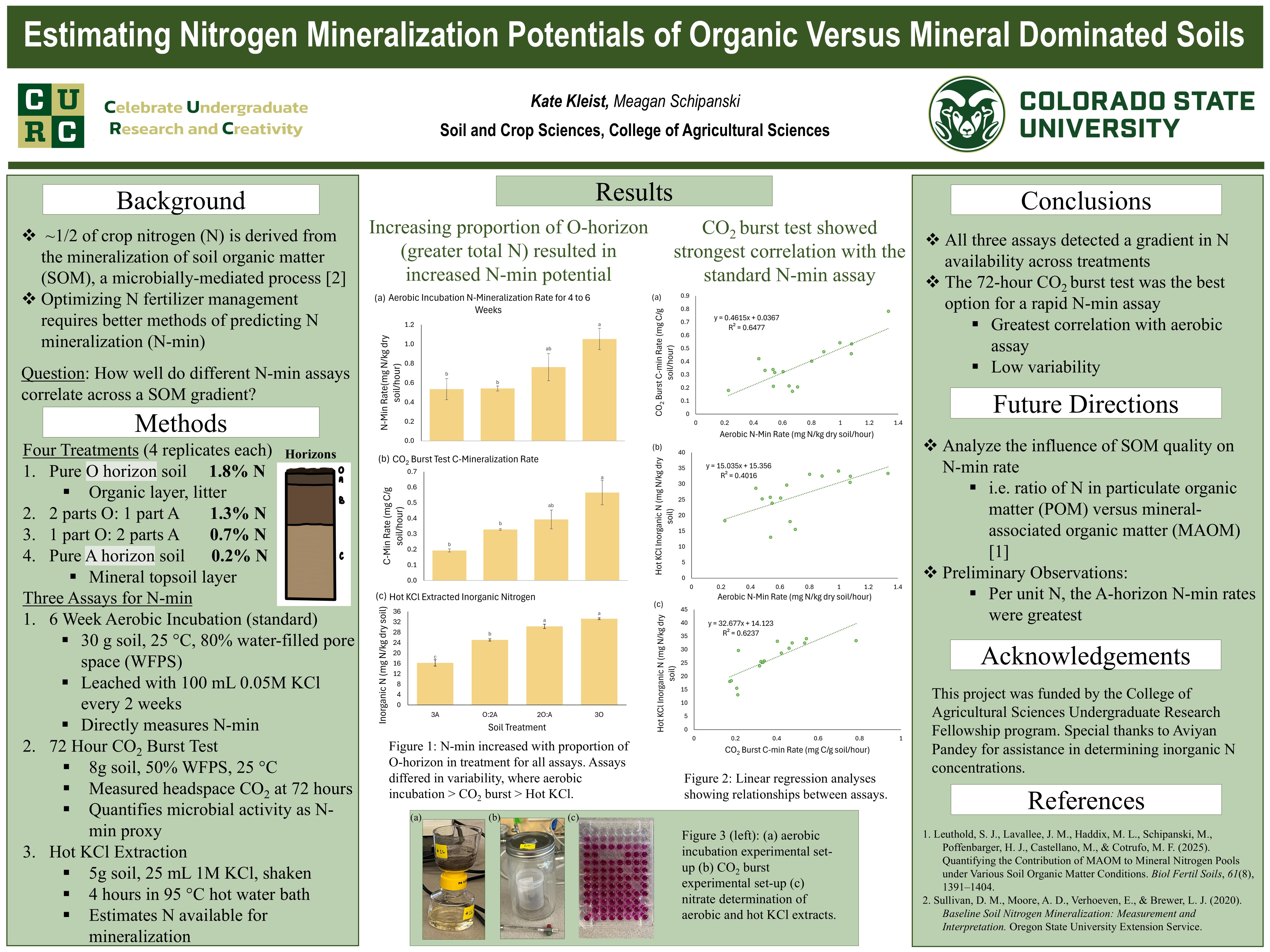
Nitrogen (N) is an essential crop nutrient that can be yield-limiting in agricultural settings. Annually, about half of crop N is derived from the mineralization of soil organic matter, while the rest is supplemented with fertilizer, of which the excess application has various environmental and economic consequences. Thus, optimizing nitrogen management requires an improved ability to predict the soil’s capacity to supply N via mineralization (N-min), which currently is challenging to do. Aerobic incubations are often considered the standard for measuring soil N-min potential, making them a good comparison for more rapid, accessible assays. This study examined the correlation between three different methods of estimating N-min potential—a 6-week aerobic incubation, a 72-hour CO2 burst test, and a hot KCl extraction. These methods were analyzed for four soil treatments — pure O-horizon soil, pure A-horizon soil, and 2:1 and 1:2 O:A horizon soil mixtures— to see how the varying N quantity and quality of the two horizons influence N-min potential. Preliminary results from the 72-hour CO2 Burst Test showed that as total nitrogen content in the soil increased (increasing proportion of O-horizon), so did the soil respiration rate, a proxy for N-min. When respiration rate was standardized by soil N content, the A-horizon significantly surpassed the mineralization rate of the other treatments. This suggests that N quality (e.g., the lower quantity of N in particulate organic matter (POM) versus mineral-associated organic matter (MAOM) in the A-horizon) and not just quantity influences potential N-min. Analysis of results is ongoing.