
Investigating Novel Sources of Resistance to Wheat Stem Sawfly, a Devastating Pest of Wheat
Category: Research Poster
Author(s): Emily Huerta, Adam Osterholzer, Punya Nachappa
Presenter(s): Emily Huerta
Mentors(s): Punya Nachappa
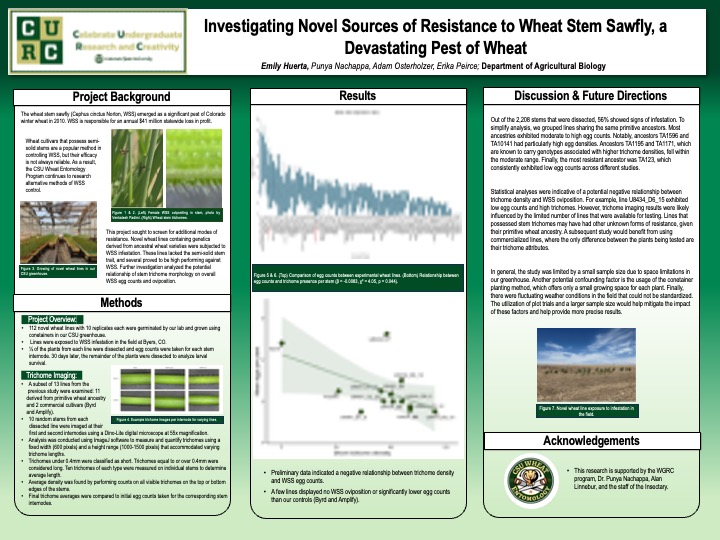
The wheat stem sawfly (Cephus cinctus, WSS) is a major wheat pest that reduces yields by damaging stem tissues and causing lodging. It is estimated that WSS damage results in a $41 million loss every year in CO. Its larvae are stem-boring and well-protected from insecticides, making them difficult to manage. Currently, the best options for growers are wheat cultivars with semi-solid stems. These lines exhibit increased pith expression, which hampers larval survival. However, this trait is not always reliable and there has been interest in supplementing the resistance mechanisms available to growers. The CSU Wheat Entomology Program sought to address this issue by screening wheat lines with potentially novel sources of resistance. These lines utilize genetics from primitive wheatgrass ancestors and do not possess the semi-solid stem trait. Over the course of this study, the experimental plants were grown in a greenhouse and then exposed to WSS infestation at Byers, CO. Egg counts and subsequent larval survival were recorded for each line in the screening. Several lines were high-performing and merited future study to investigate their underlying resistance mechanisms. Our lab also imaged select lines with stem trichomes, hypothesizing that increased trichome density would result in lower WSS egg counts. While we observed a negative correlation between trichome density and oviposition, further screening is required for verifying the effect of this trait.