
Letting Tau Go: A New Route for Protein Clearance in Alzheimer's Disease
Category: Research Poster
Author(s): Steven Payne, David Crosby, Ariana Dolce, Thomas LaRocca, Dakota Peart
Presenter(s): Steven Payne
Mentors(s): Daniel Lark
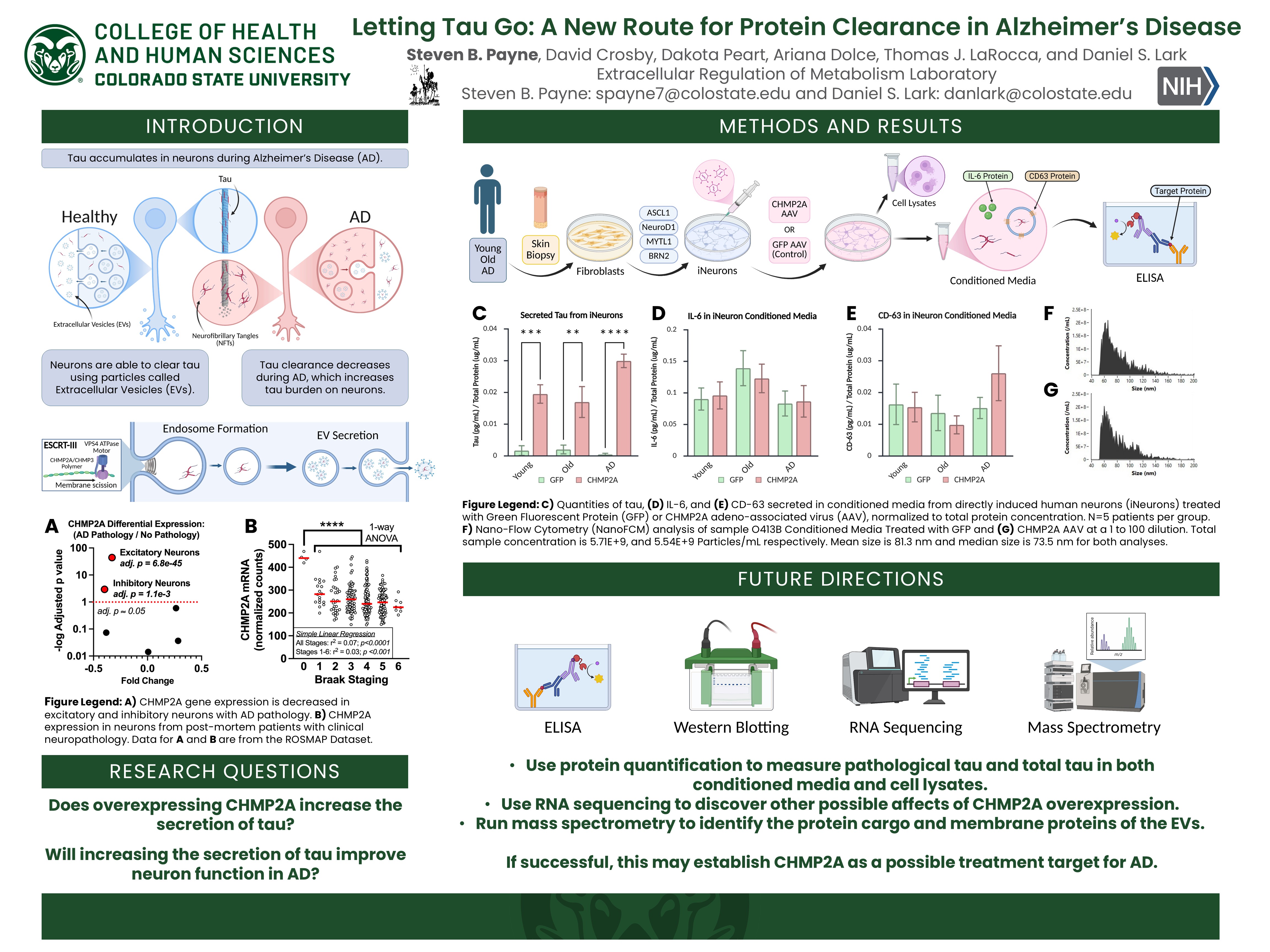
Alzheimer’s disease (AD) is a neurodegenerative disorder affecting over 7 million Americans. Tau is a neuronal protein that supports normal cellular function. In AD, tau becomes abnormally modified and accumulates in aggregates that contribute to cognitive impairment. We believe that clearing pathogenic tau from neurons may slow the progression of AD. The brain has transport machinery that clears proteins from cells through endosome formation. Endosome formation is heavily dependent on ESCRT proteins, like CHMP2A. CHMP2A gene expression in neurons is lower in donors with AD than in age-matched donors without AD. Restoring CHMP2A levels using an adeno-associated virus (AAV) in directly induced neurons (iNeurons) decreases intracellular tau by ~50% by increasing tau release. However, this treatment does not have a significant effect on the amount of inflammation marker IL-6 protein or extracellular vesicle (EV) marker CD63 protein in the extracellular conditioned media. These findings show that restoring CHMP2A expression increases tau release by neurons. However, this increased release of tau may be independent of endosome formation because EV concentration (CD63) is unchanged. To investigate the mechanism of this release, we will measure tau found in EVs released by iNeurons after restoring CHMP2A expression. We will also measure cellular gene expression using RNA sequencing to identify other pathways that could explain how these cells are able to release more tau protein.