
Comparative study of chronic wasting disease using natural and synthetic prions
Category: Research Poster
Author(s): Lacey Russell, Carlos Diaz Dominguez, Zoe Atkinson, Jenna Crowell, Joseph DeFranco, Sehun Kim, Glenn Telling
Presenter(s): Lacey Russell
Mentors(s): Joseph DeFranco
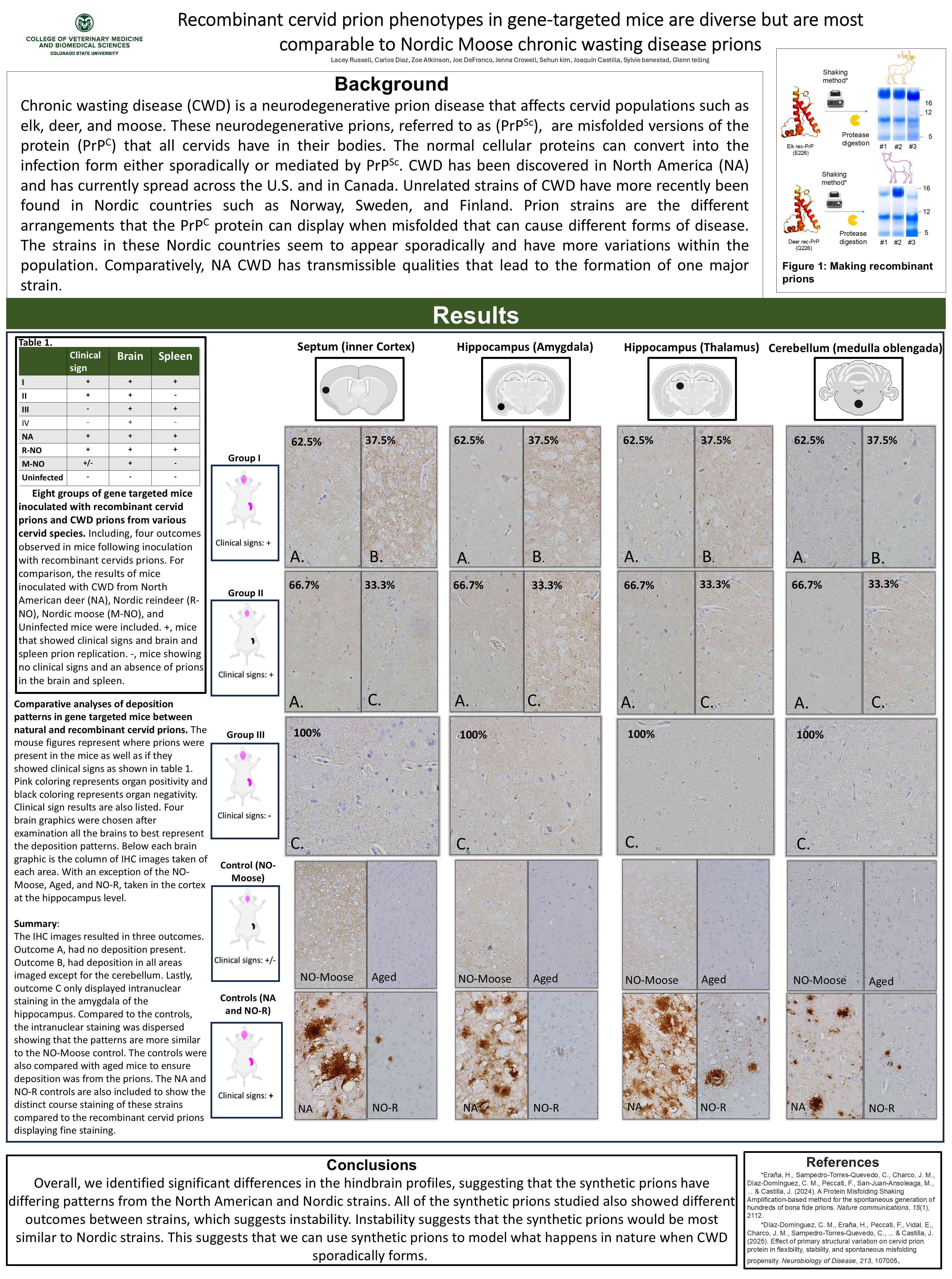
Chronic wasting disease (CWD) is a neurodegenerative, infectious prion disease that affects cervid populations such as elk, deer, and moose. Prions (PrPSc) are misfolded infectious proteins derived from the the normal cellular prion protein (PrPC). This conversion can happen sporadically or mediated by PrPSc. CWD has been discovered in North America (NA) and currently has spread across the U.S. and Canada. Unrelated CWD strains have more recently been found in Nordic countries. Prion strains are the distinct conformations that proteins can display when misfolded from PrPC that can cause different forms of the disease. In Nordic countries the strains seem to appear sporadically and have more variations within the population. Comparatively, NA CWD has transmissible qualities that lead to the formation of one major strain. In order to model the naturally occurring CWD patterns-one major strain in NA and diverse sporadic cases in Nordic countries- we inoculated synthetic prions in gene-targeted mice. Here, we studied the brains of infected cervids from NA and Nordic countries and compared them to the brain of the mice inoculated with synthetic prions by studying the prion deposition patterns among different strains. We found significant differences in hind brain profiles suggesting that the synthetic prions have differing patterns from NA and Nordic strains. Within the synthetic prions studied, all of them showed different outcomes and suggest strain instability. These findings highlight similarities and differences between synthetic and natural prions and suggests that synthetic prions are more unpredictable and have significantly different pathological profiles.