
Undergraduate neuromuscular physiology lab course project: Sympathetic arousal and muscle force output
Category: Research Poster
Author(s): Katie Fray, Brian Tracy
Presenter(s): Katie Fray
Mentors(s): Brian Tracy
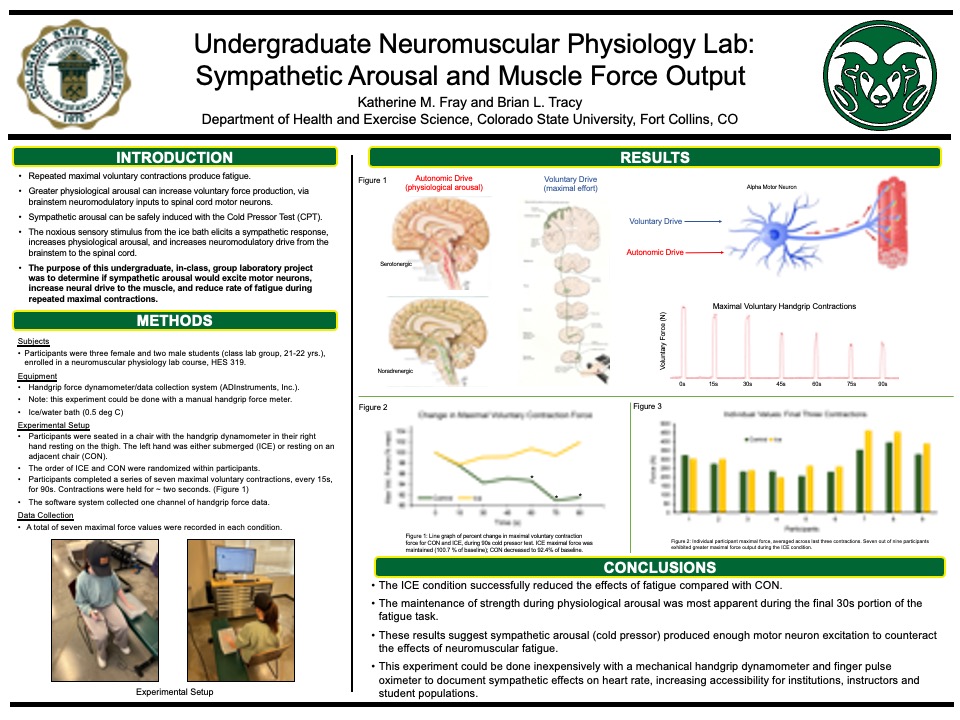
Undergraduate neuromuscular physiology lab course project: Sympathetic arousal and muscle force output Katherine M. Fray, Brian L. Tracy Department of Health and Exercise Science, Colorado State University, Fort Collins, CO. Voluntary cortical drive and brainstem excitatory drive are important influences on motor neuron output. Here we report on an in-class small group laboratory exercise that was part of a university course. Five students generated an experimental design to determine if sympathetic arousal would excite motor neurons, increase neural drive to the muscle, and reduce rate of fatigue. Each student performed seven maximal handgrip contractions over 90s, with (ICE) and without (CON) immersing the other hand in an ice bath (0.5 deg C). The purpose was to induce sympathetic arousal and compare the fatigue rate between CON and ICE. Maximal voluntary force was measured every 15 seconds with the teaching lab data collection system. The order of ICE and CON was counterbalanced between students. The data across time was compared between ICE and CON. For CON, the maximal force declined to 92.4% of baseline for the last three timepoints. For ICE, the maximal force was sustained at 100.7% of baseline at those same timepoints (P values 0.07, 0.08, 0.05 for the ICE vs. CON comparison). Individual responses: 7/9 of the students showed greater strength for ICE during the final 30s. This small group do-it-yourself laboratory exercise supports the idea that sympathetic arousal produces motor excitation sufficient to prevent fatigue. This experiment could be done very inexpensively, with mechanical handgrip dynamometers and pulse oximeters to document sympathetic effects on heart rate.