
Acceleration and Velocity Training Effects on Countermovement Jump Performance in Adolescent Female Athletes
Category: Research Poster
Author(s): Kamryn Klinefelter
Presenter(s): Kamryn Klinefelter
Mentors(s): Christopher Patrick
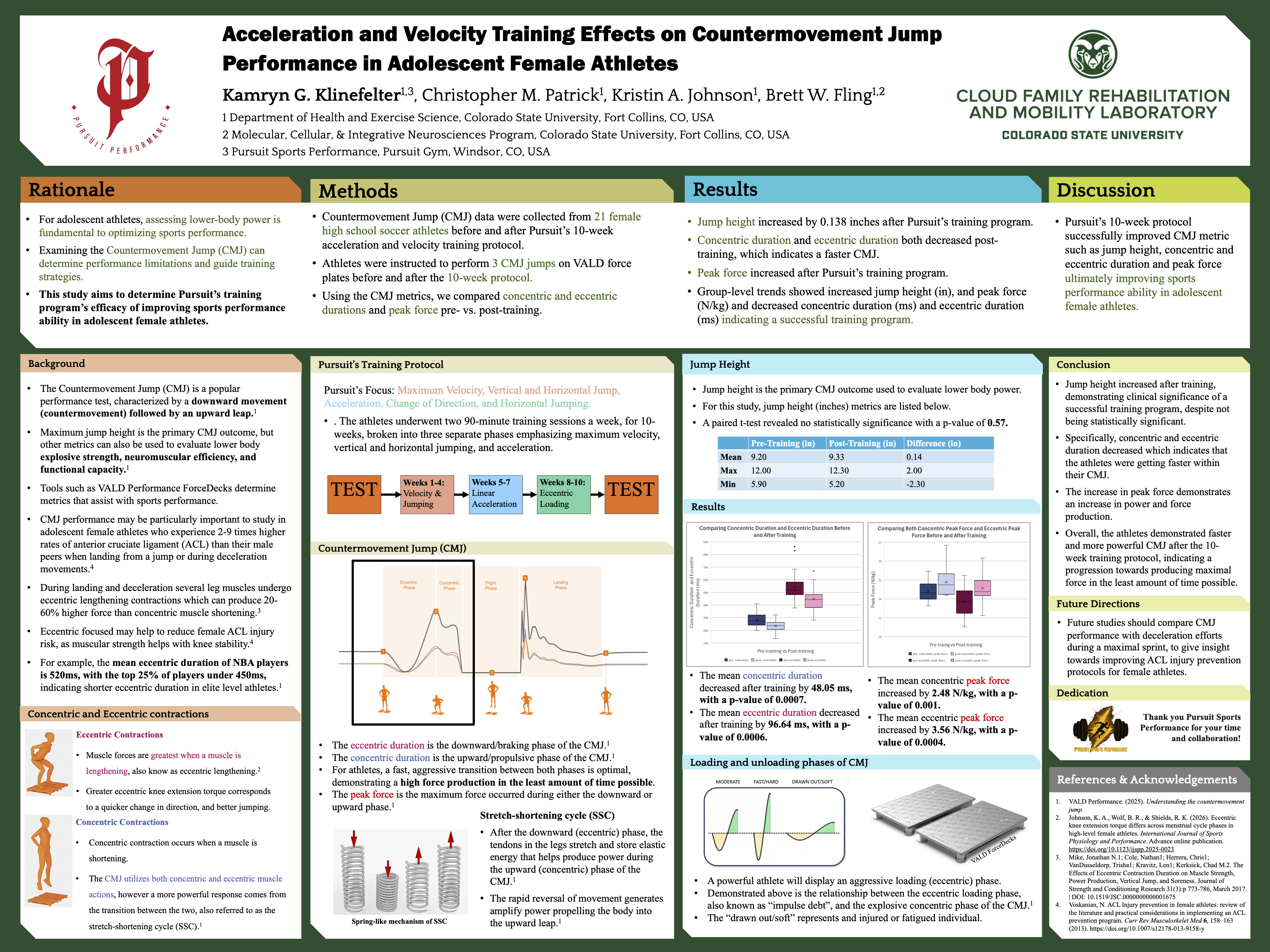
For adolescent athletes, assessing lower-body power is fundamental to optimizing sports performance. The countermovement jump (CMJ) is a widely used performance test, characterized by a rapid downward movement followed by an upward vertical jump. Maximum jump height is the primary CMJ outcome, but other metrics can also be used to evaluate lower-body explosive strength, neuromuscular efficiency, and functional capacity. Specifically, examining contributions of the eccentric and concentric phases within a CMJ can determine performance limitations and guide training strategies. An accelerated eccentric phase may increase stored energy, contributing to greater peak force production while minimizing metabolic demand and fatigue. Improving eccentric lengthening may enhance explosive concentric phase of the CMJ. Pursuit Sports Performance (Pursuit) program, focusing on velocity and acceleration, aims to improve such eccentric muscle lengthening efficacy. However, little is known about the effectiveness of such programs in improving eccentric phase characteristics during CMJ performance. The purpose of this study was to evaluate the effectiveness of Pursuit’s 10-week acceleration and velocity training protocol to improve CMJ performance metrics. CMJ data were collected from 21 female high school soccer athletes before and after the training program. The training program was structured into three phases, emphasizing maximum velocity, vertical and horizontal jumping, and acceleration. Eccentric and concentric phase durations and peak power metrics were analyzed pre- and post-training to determine the magnitude a direction of changes resulting from the training program. These findings may help inform the use of phase-specific CMJ metrics to guide individualized programs and optimize athlete development.