
Chronic Smoke Exposure Impact on Spermatogenesis in Male Mouse Model.
Category: Research Poster
Author(s): Porter Blei, Rose Reiter, Jacob Smoot, Luke Montrose, Madison Johnson, Avery Lessard
Presenter(s): Porter Blei
Mentors(s): Luke Montrose, Jacob Smoot
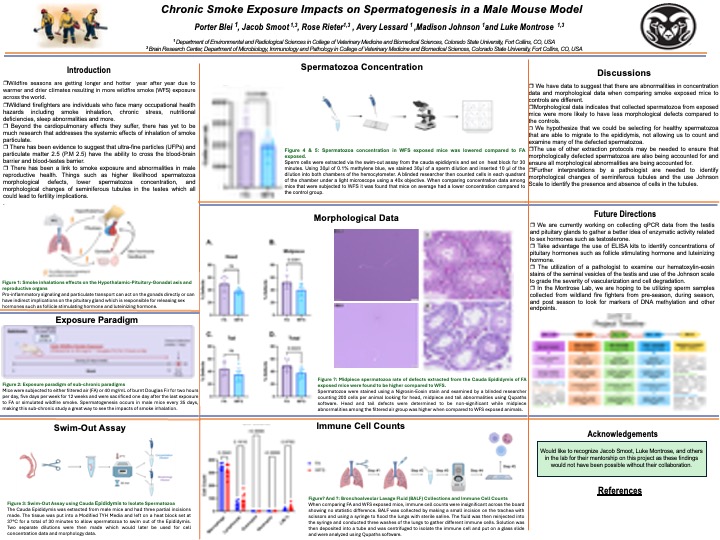
Wildland firefighters are an underrepresented occupational group exposed to numerous occupational health hazards that can negatively impact long-term health. Substantial literature has demonstrated that cardiopulmonary effects occur following chronic exposure to smoke particulates, including increased blood pressure, altered breathing patterns, and increases in cardiopulmonary inflammation. Recent observational data suggests wildfire smoke can also affect the neuroendocrine and reproductive systems. However, a large knowledge gap continues to exist regarding mechanisms. There has been evidence to indicate that PM2.5 and ultrafine particulate matter can cross the blood-testis barrier and blood-brain barrier, having a direct, indirect, or collaborative effect on the male reproductive system, but more data is still needed. To gain knowledge on this issue, we conducted a chronic smoke exposure study using a male mouse model over a three-month period to see how smoke particulate from burnt Douglas fir impacts these processes, specifically spermatogenesis in males. Mice were subjected to 40 mg/ml of burnt Douglas fir for 5 days a week over three months in a smoke exposure chamber at the Colorado State University campus. After the exposure, the mice were sacrificed, and we extracted tissues to examine different endpoints. We performed morphology assays, spermatozoa concentration, and H&E stains to grasp how spermatogenesis may be impaired. Preliminary findings are suggesting low levels of morphological abnormalities and low concentration in sperm from exposed mice. A possible explanation for this could be the high dosage and prolonged exposure could have selected for healthy spermatozoa with the ability to swim out of the epididymis.