
Improved Snowpack Bulk Density Estimates from Snow Depth
Category: Research Poster
Author(s): Samantha Nauman, Cassandra Lange
Presenter(s): Samantha Nauman, Cassandra Lange
Mentors(s): Steven Fassnacht
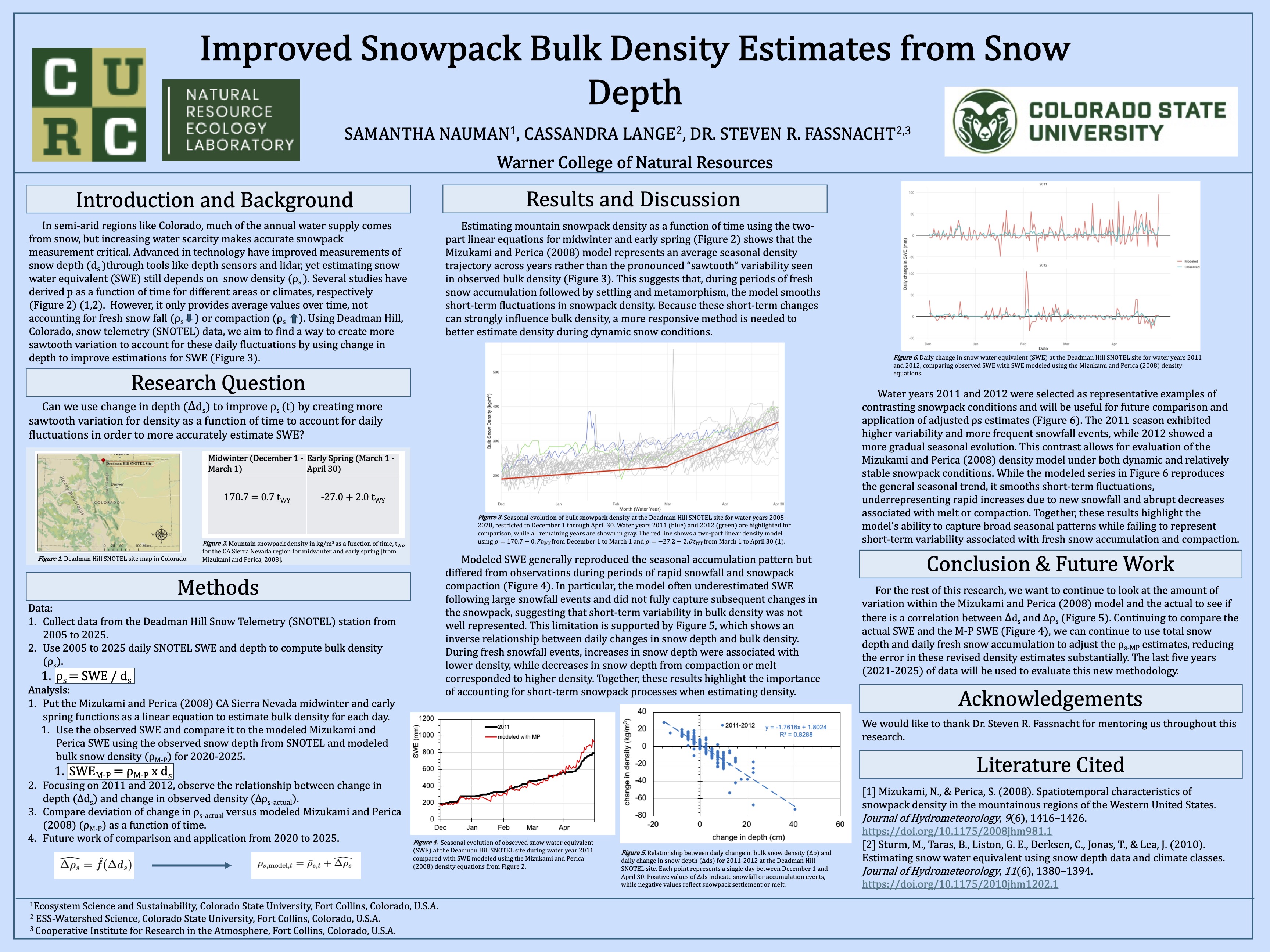
Water resources are becoming more scarce across much of the world, especially in semi-arid regions like Colorado, where a majority of the water comes from snow. It has become easier to measure snow depth (ds) using recent technological advances such as sonic and laser depth sensors, snow poles with cameras, lidar, and photogrammetry. However, to accurately represent how much water is in storage for yearly allotment, density (ρs) is necessary to estimate snow water equivalent (SWE). Several studies, such as Mizukami and Perica (2008; https://doi.org/10.1175/2008JHM981.1) and Sturm et al. (2010; https://doi.org/10.1175/2010JHM1202.1), have derived ρs as a function of time for different areas or climates, respectively. The approaches prove good approximations of the seasonal evolution of ρs, but do not account for the daily fluctuations due to fresh snow accumulation and subsequent metamorphism and compaction. This work aims to improve the temporal evolution density estimation methods to consider these shorter-term fluctuations. Here, snow telemetry (SNOTEL) data from various sites across the western United States were used with snow depth data to improve ρs estimates. Daily SNOTEL SWE and depth were used to compute bulk density (ρs-actual) for the period 2005-2020. The Mizukami and Perica (2008) two-part linear snowpack density equations were used to provide an initial estimate of ρs-MP for each day. The difference between ρs-actual and ρs-MP was up to 75 kg/m3. The total snow depth and daily fresh snow accumulation were then used to adjust the ρs-MP estimates, reducing the error in these revised density estimates substantially. The last five years (2021-2025) of data were used to evaluate this new methodology.