
Black Bears (Ursus americanus) and Natural Food Sources in the Methow Valley Watershed, Washington.
Category: Research Poster
Author(s): Danielle Terry
Presenter(s): Danielle Terry
Mentors(s): Tianying Wang
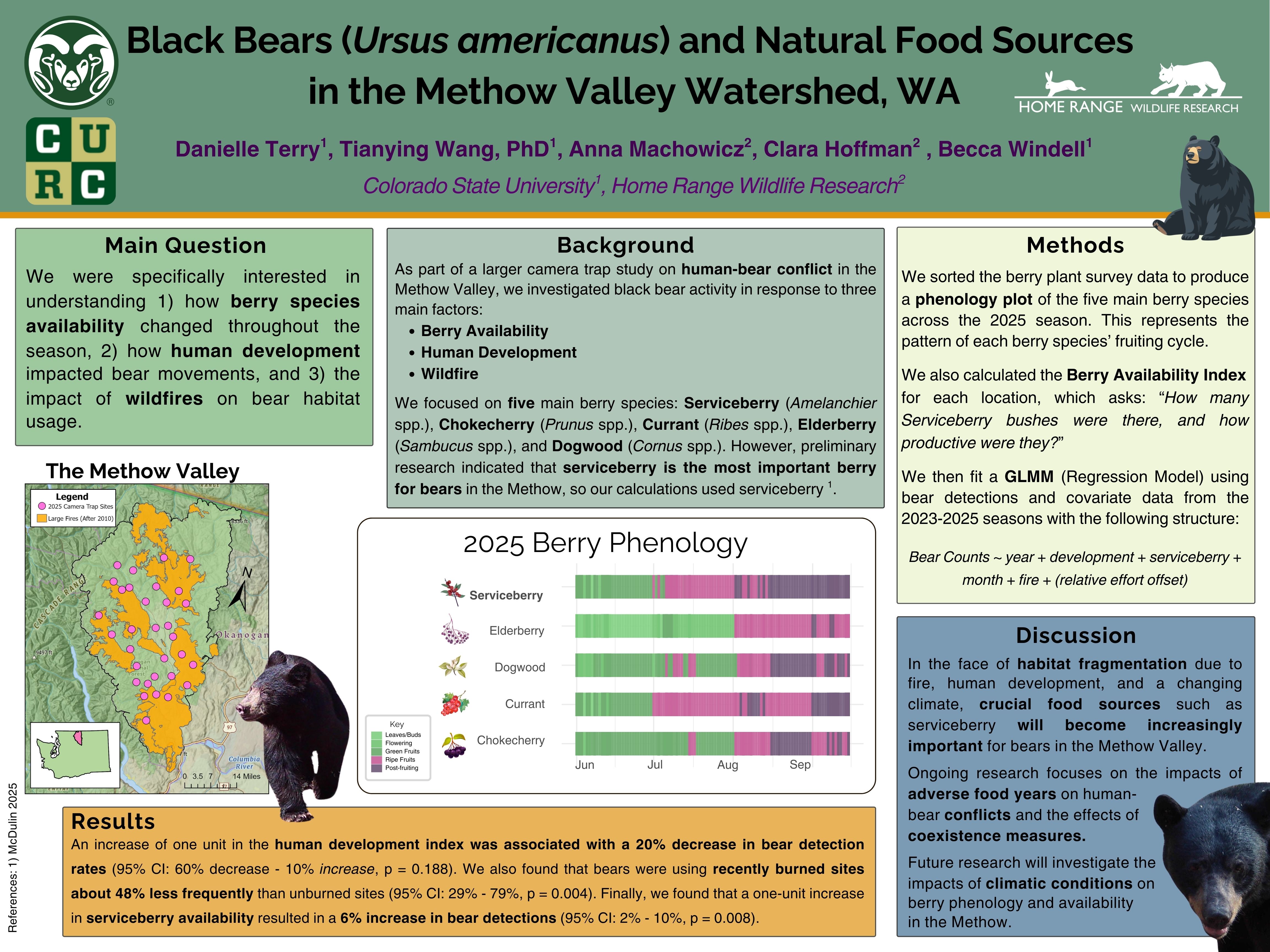
Human-wildlife coexistence is essential for conservation efforts. This is particularly true in areas where human development adjoins natural areas. The Methow Valley Watershed in Methow, Washington, is a good example of a wild-urban interface landscape where human activities often overlap with wildlife. As part of a larger community-science-driven project, we investigated the impact of natural food sources (represented by five main berry species) on black bear (Ursus americanus) movements within the Methow Valley using camera traps and vegetation transect surveys. We were specifically interested in understanding 1) how berry species availability changed throughout the season, 2) how human development impacted bear movements, and 3) the impact of wildfires on bear habitat usage. We fit a GLMM (General Linear Mixed Model) to understand the associations between each factor and bear detections. We found a strong association between fire history and Serviceberry (Amelanchier spp.) availability and a weaker effect of human development on bear detection rates. This research highlights the importance of coexistence measures such as conflict-reduction tools and public education in fostering collaborative efforts in areas with bear-human population overlap.