
Tissue-specificity and genetic adaptation impact fibroblast replication rates under hypoxia in deer mice
Category: Research Poster
Author(s): Halle Banks
Presenter(s): Halle Banks
Mentors(s): Kathryn Wilsterman, Ashley Larson
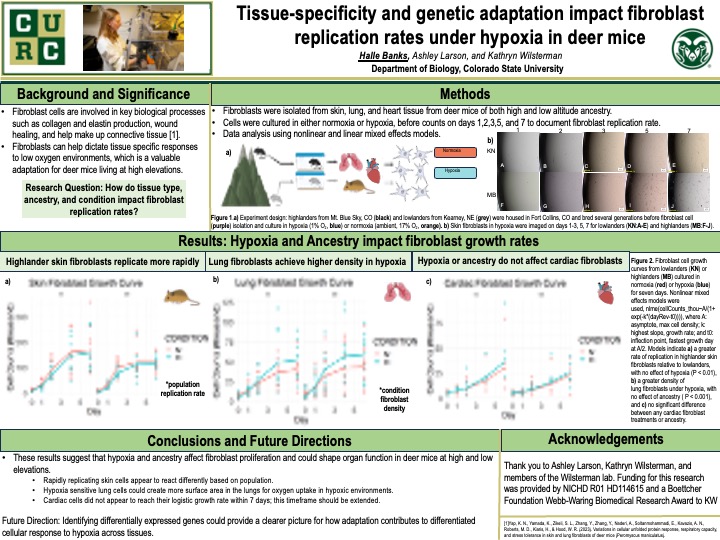
High altitudes fundamentally challenge physiology through both low oxygen and cold. Highland-adapted species, including the North American deer mouse (Peromyscus maniculatus), possess genetic adaptations that improve performance in part through altered physiological responses to low oxygen. In most cases, these adaptive responses must be tissue-specific. Here, we asked how tissue identity impacts ancestry-dependent responses to low oxygen by comparing the replication rate of primary fibroblast cells isolated from lung, heart, and skin between adapted and non-adapted deer mice. We found that the density at which the replication of lung fibroblast replication plateaued was greater under hypoxia (P < 0.001), but this did not differ by ancestries. In contrast, skin fibroblast replication rates were greater in highland-ancestry mice relative to lowlanders (P < 0.01), but both ancestries were insensitive to hypoxia. Cardiac fibroblast replication rates did not differ by treatment or ancestry. Our results demonstrate that tissue-specific fibroblast identity persists in vitro in deer mice; however we did not find evidence of ancestry-specific responses to hypoxia at the level of replication rate. Combining these experiments with transcriptomics will provide a clearer picture of how adaptation contributes to differentiated cellular responses to hypoxia across tissues.