
Exploring undergraduate student stressors in asynchronous online and in-person settings.
Category: Research Poster
Author(s): Sofie Handwerker, Abigail Clarkin, Jordan Young
Presenter(s): Sofie Handwerker, Abigail Clarkin, Jordan Young
Mentors(s): Greta LeDoyen
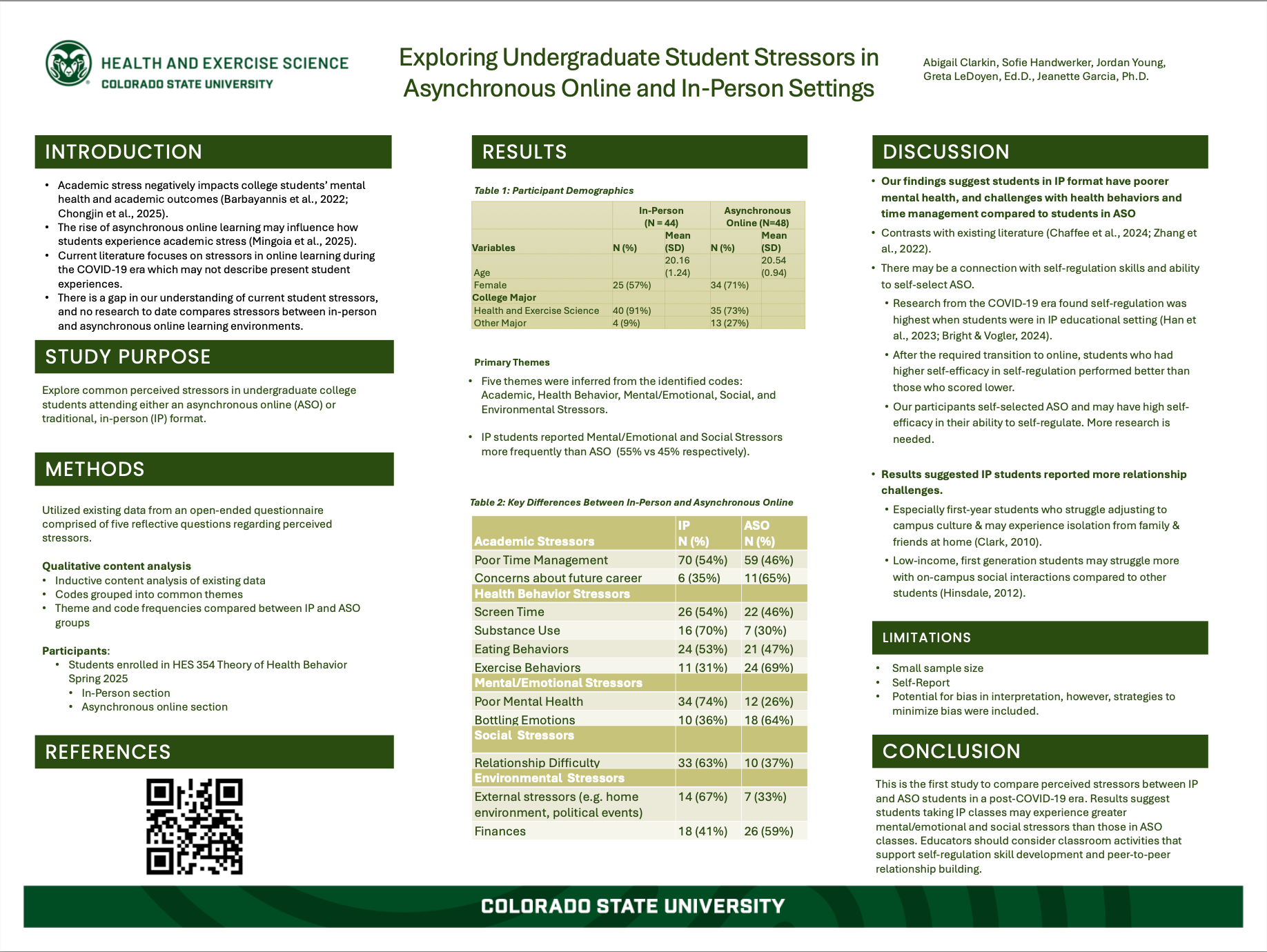
Prolonged, elevated levels of stress in college students can lead to both adverse physical and psychological health outcomes, as well as poor academic performance. By better understanding the internal and external stressors experienced by a diverse range of adult learners, both educators and support staff could make better informed course management and curriculum decisions which may mitigate sources of academic stress. Interestingly, little is known regarding potential differences in personal, social, and environmental stressors in students according to course modality (e.g. in-person, asynchronous). Therefore, the purpose of this qualitative study is to explore common perceived stressors in undergraduate college students attending either an asynchronous online (ASO) or traditional, in-person (IP) format. Methods: This qualitative design utilized existing data from an open-ended self-reflection assignment completed in a 300-level Health and Exercise Science course, the Theory of Health Behavior, offered in two different modalities, IP (n=44), and ASO (n=44). A content analysis was conducted to identify the frequency of commonly mentioned stressors across the data set and within groups. Results: Preliminary analyses suggest overwhelming responsibilities, poor time management skills, and inadequate sleep are common stressors across groups. ASO students reported overwhelming responsibilities, screen time, and substance use more frequently than in-person students. Implication: By better understanding perceived sources of stressors across students as well as those specific to students in each course format, educators and curriculum managers could consider these differences when planning curriculum. Future research could consider developing intra-curricular interventions to help manage sources of stress within the two course formats.