
Intervening Proteins Regulate Archaeal DNA Replication
Category: Research Poster
Author(s): Emmanuelle Knecht, Emma Blount
Presenter(s): Emmanuelle Knecht
Mentors(s): Thomas Santangelo, Gabriel Spalink
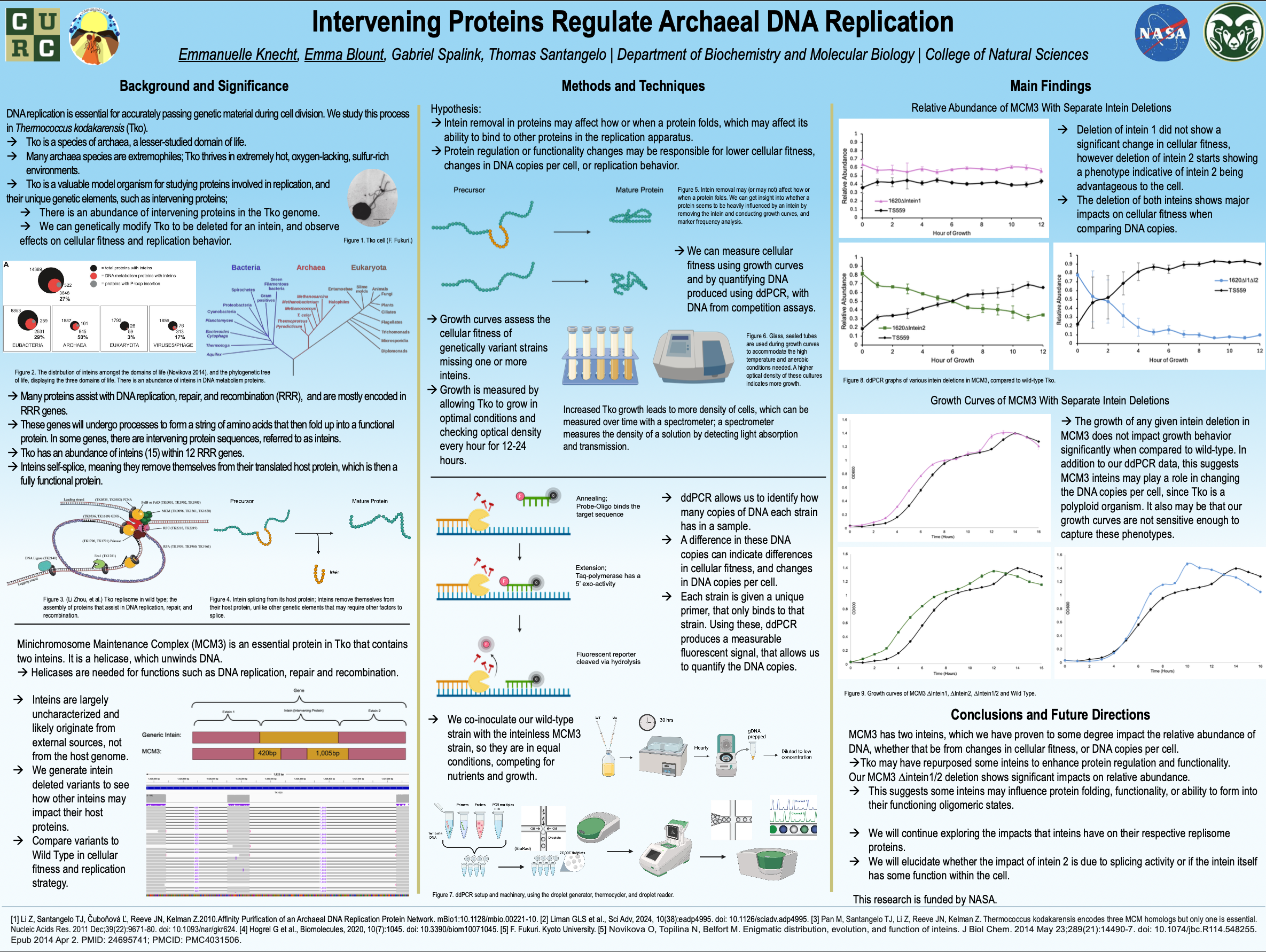
DNA replication is fundamental for cellular division and genome integrity, where errors result in disease states, including cancer. Given the importance of replication, an array of various proteins form a replication apparatus we call the replisome. The replisome is responsible for orchestrating DNA replication efficiently and resolving the associated errors. In this DNA regulating complex, essential proteins are encoded in replication, repair, and recombination (RRR) genes. Many of these genes also encode special intervening proteins known as inteins, which function by removing themselves from their host protein, and originated from unknown external sources rather than the host genome. Our organism of study, Thermococcus kodakarensis (Tko), is an archaeon, in a different domain than eukarya (humans, plants, etc.) and bacteria, and is adapted to extreme, oxygen-lacking and hyper-thermal environments. We know that in the genome of Tko, an abundance of inteins are encoded within RRR genes. Despite their abundance, the function of these inteins remains largely unknown. To better understand how Thermococcus kodakarensis may use inteins, we are constructing genetically modified variants with individual intein deletions to see the effects on replication strategy and cellular fitness. We have already successfully generated several intein-deleted strains of Tko and have observed resultant impacts to overall cellular fitness, replicative strategy behavior, and total DNA content. While inteins have traditionally been regarded as merely genetic parasites, we are challenging this long-held paradigm with a growing body of evidence demonstrating the beneficial role between inteins and their host organisms.