
Hop latent viroid: First report of vector transmission in hemp (Cannabis sativa)
Category: Research Poster
Author(s): Raiyaa Huntress, Jinlong Han, Jacob MacWilliams
Presenter(s): Raiyaa Huntress
Mentors(s): Punya Nachappa
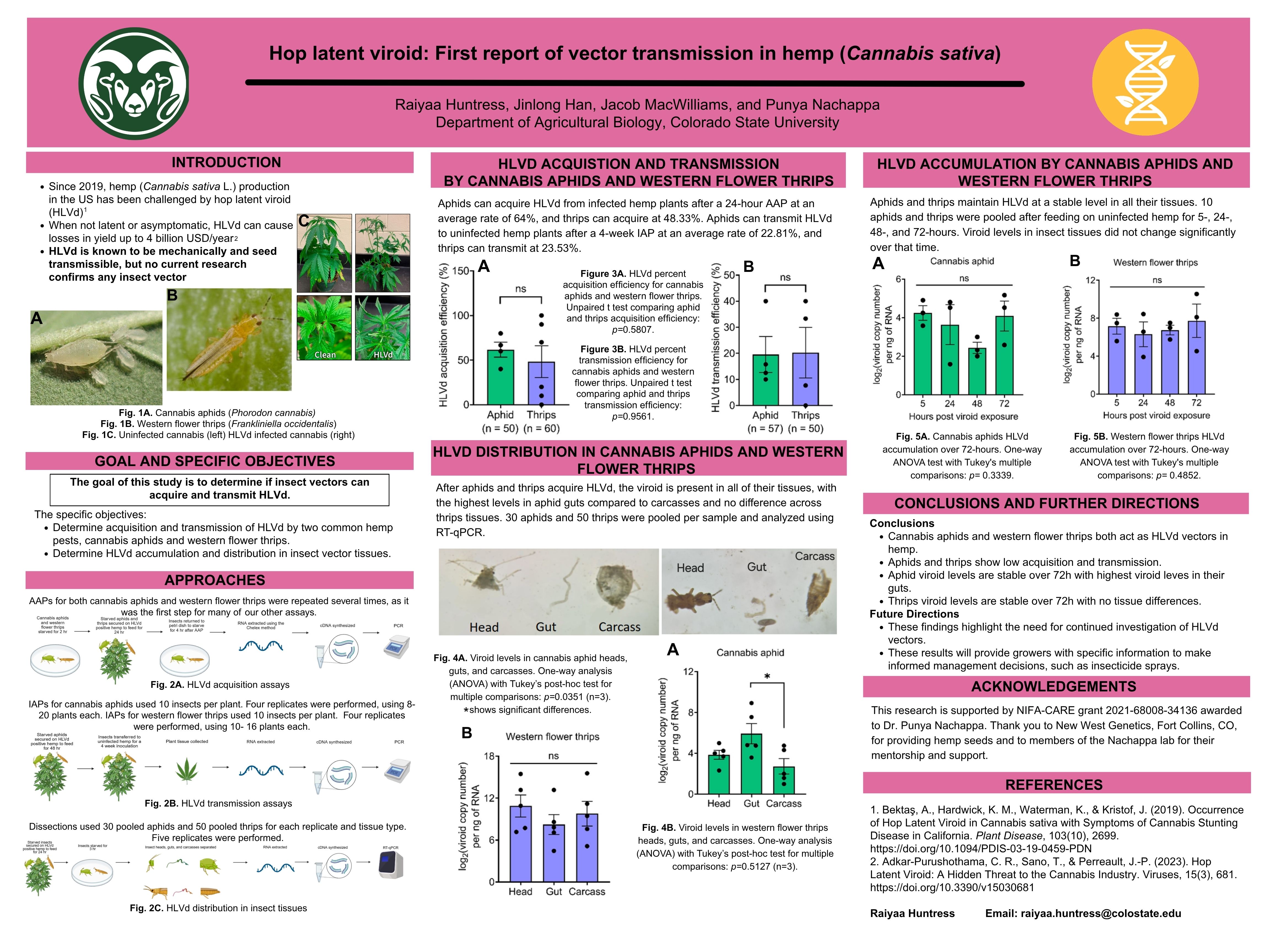
Since the 2018 U.S Farm Bill reintroduced industrial hemp (Cannabis sativa L., < 0.3 % dry weight THC) back into the agricultural landscape, the crop has faced an influx of pests and pathogens. Among them, hop latent viroid (HLVd) has risen to the highest threat level. HLVd is a single-stranded, 256 bp circular RNA molecule causing leaf chlorosis, stunted growth, and reduced yield and quality of cannabinoids and terpenes. Losses due to HLVd in C. sativa (hemp and marijuana, >0.3% THC) are estimated to be upwards of $4 billion per year. HLVd is known to be transmitted mechanically, but there is currently no information regarding any possible insect vectors. Here we evaluated vector transmission by two common hemp pests, cannabis aphids (Phorodon cannabis) and western flower thrips (Frankliniella occidentalis). We hypothesize that P. cannabis and F. occidentalis can acquire and transmit HLVd to hemp. In this study, we aimed to determine the acquisition and transmission of HLVd by these insects, and to assess HLVd accumulation and distribution in the insect vector tissues. Our results reveal that cannabis aphids and western flower thrips acquire and transmit HLVd at low rates. Aphids and thrips maintain HLVd in all their tissues at a stable level; aphids show the highest viroid levels in their guts compared to carcasses and thrips show no significant differences across tissues. Knowledge of insect vectors will provide hemp growers with a better understanding of this disease and develop targeted management strategies to avoid economic losses.