
The grass may be greener on the other side: Germination of Bouteloua gracilis cultivars on a soil moisture gradient in the context of post-drought restoration
Category: Research Poster
Author(s): Sean Kirkpatrick, Carlie Clemmer
Presenter(s): Sean Kirkpatrick
Mentors(s): Melinda Smith, Madelyn Amick
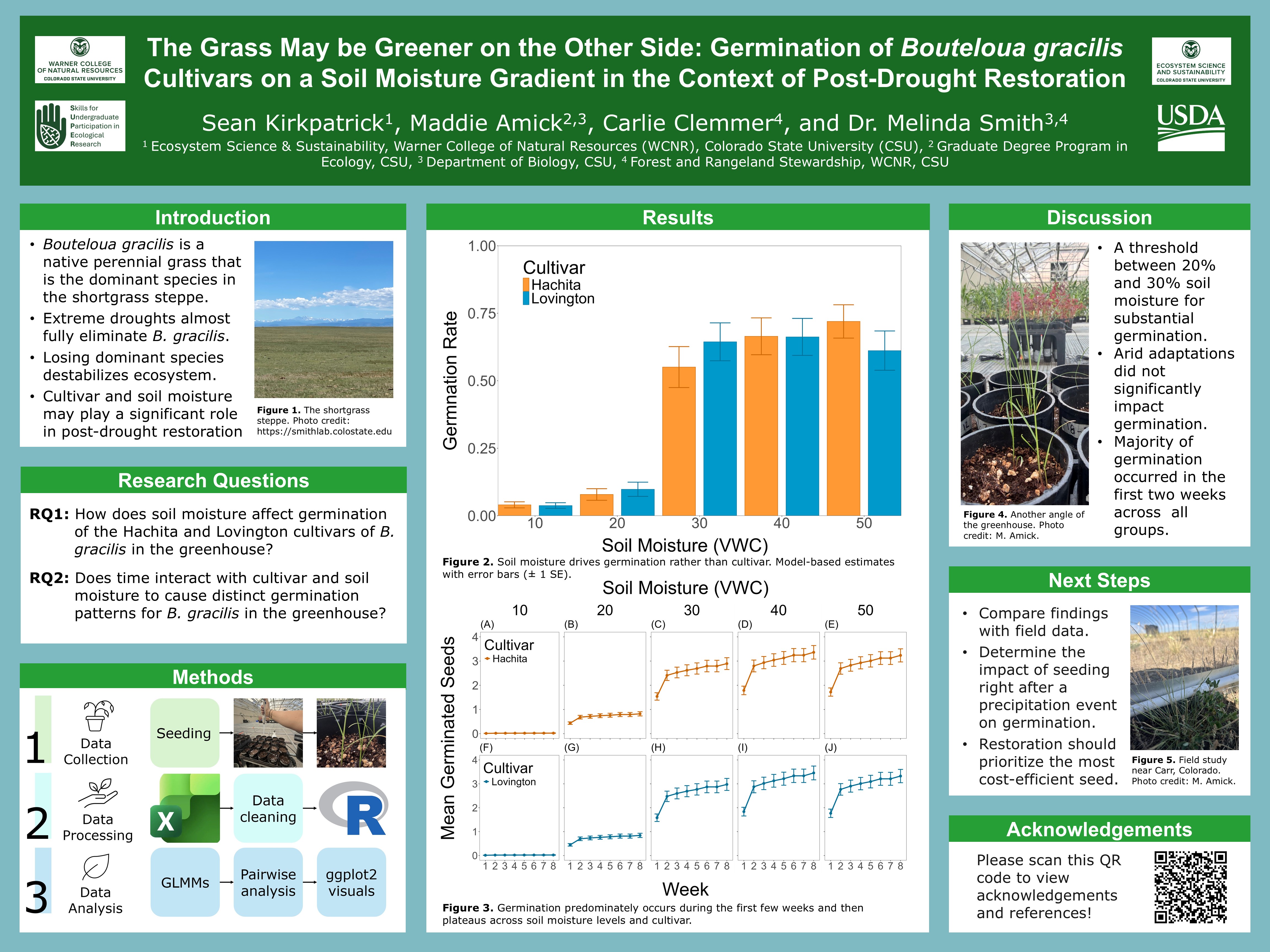
Drought severity and frequency are expected to increase in Colorado’s drylands in the coming years, including in the shortgrass steppe ecosystem. Bouteloua gracilis, the native dominant species in the shortgrass steppe, was found to severely decline in abundance during and after drought. The decline of B. gracilis greatly disrupted ecosystem services and functioning. We investigated how key environmental factors and seeding decisions influenced post-drought restoration by conducting a controlled greenhouse study analyzing the impacts of soil moisture and cultivar selection on germination. We hypothesized that soil moisture (10/20/30/40/50%) would be the major driver of germination up to a threshold, and that the xeric-adapted Hachita cultivar would perform better under water stress compared to the mesic-adapted Lovington cultivar. Findings demonstrate that soil moisture is the primary driver of B. gracilis germination until a threshold of 30% volumetric water content (VWC) is reached (10% = 3.59% vs. 30% = 64.82%, p < 0.01); however, they also indicate that cultivar selection did not have a significant impact on germination rate (p ≥ 0.46). The soil moisture level, not cultivar choice, drove germination. Pairing these results with existing field-based data can strengthen the understanding of key factors pertaining to post-drought B. gracilis seeding.