
Feral Horse Resource Selection in Utah, Sulphur Herd Management Area
Category: Research Poster
Author(s): Elyse Wilson
Presenter(s): Elyse Wilson
Mentors(s): Saeideh Esmaeili
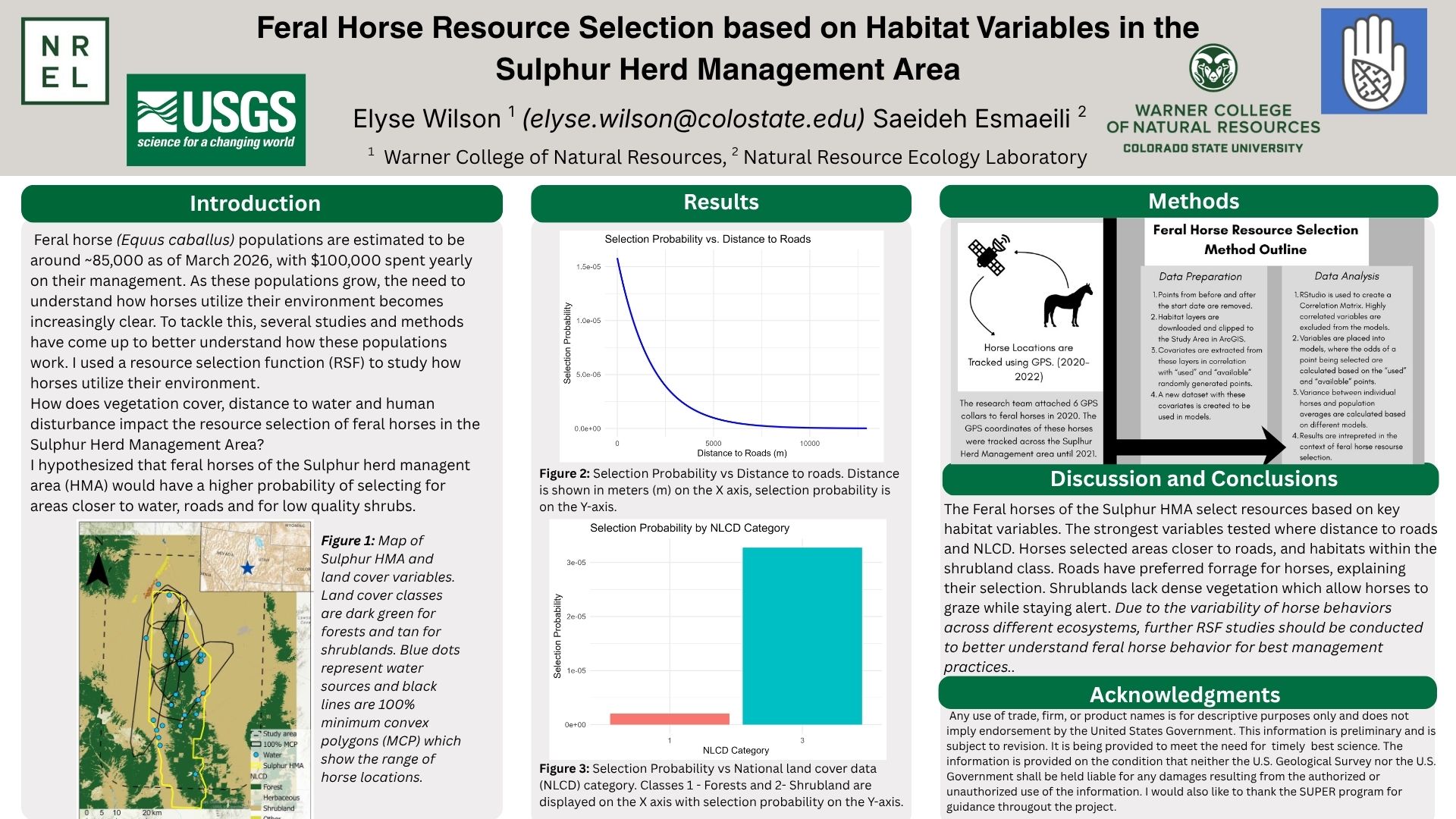
Resource selection analysis is a critical tool in understanding how animals use their environment. With an estimated population of ~85,000individuals and over $100 million spent per year on their management, the challenge of managing feral horses (Equus caballus) is becoming more apparent. To understand how horses use their habitat, six feral horses were fitted with GPS collars and their locations were collected in the Sulphur Herd Management Area, Utah, during 2020 and 2021.We used habitat variables known to affect feral horses, including elevation, Euclidian distance to water and roads, land cover classes, Enhanced Vegetation Index (EVI), and percentage of bare ground. Resource selection functions compare habitat covariates between locations used by animals and those available to animals through a use-availability design. We compared habitat covariates between X used points and Y available points generated per used point within the 100% minimum convex polygon surrounding individual horses’ GPS locations using binomial logistic regressions. Preliminary results suggest that EVI, representing vegetation greenness, and distance to water were significant factors in feral horse resource selection. These results correspond with similar studies throughout the western United States and Canada. Our findings provide a better understanding of how feral horses use different resources and share the habitat with other native ungulates.