
An Agent-Based Model of Cattle Weight Gain Under Varying Grazing Intensities
Category: Research Poster
Author(s): Alyssa Singh, Spencer Burkhart
Presenter(s): Alyssa Singh
Mentors(s): Spencer Burkhart, Randall Boone
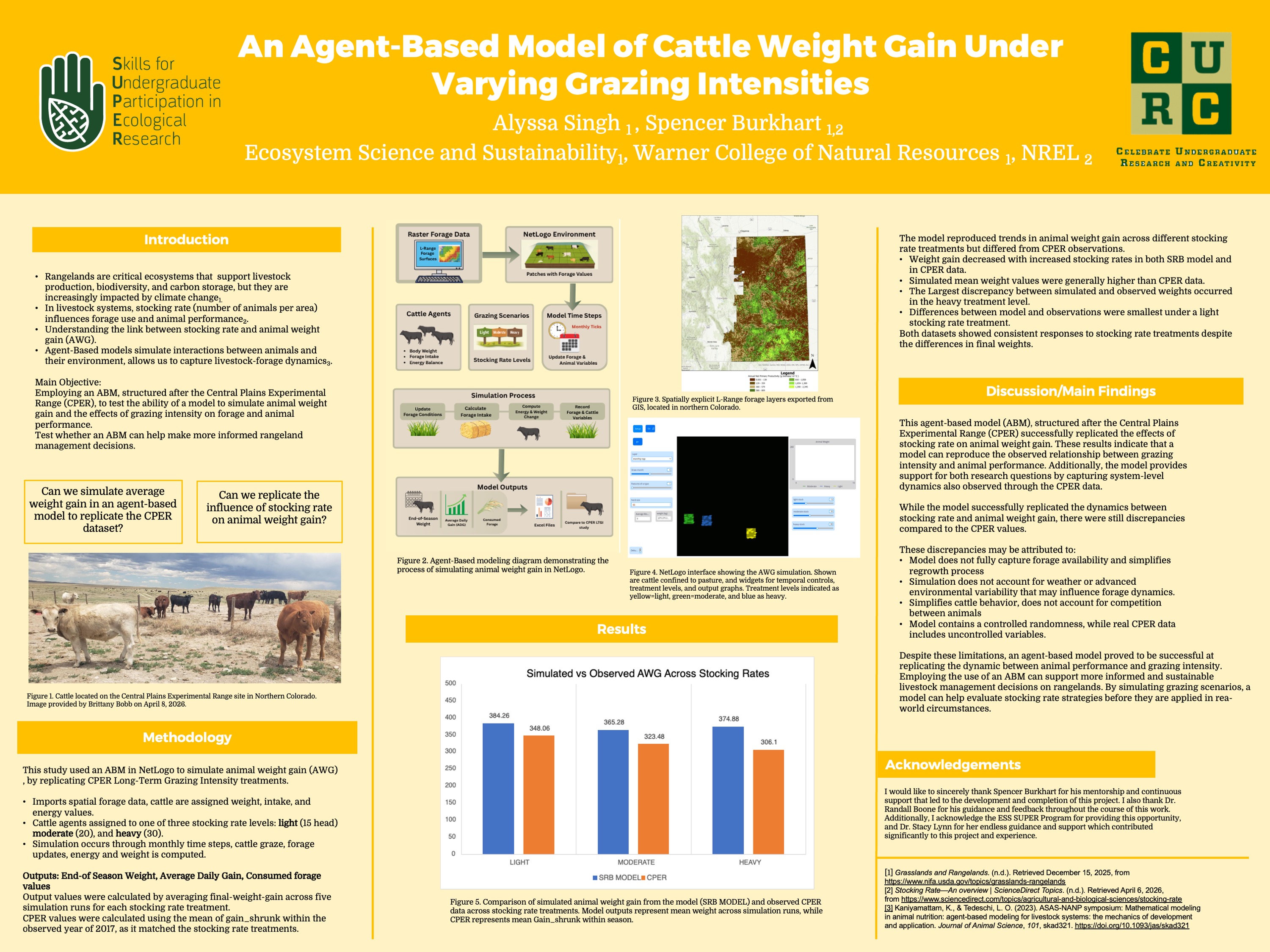
Rangelands support livestock production but are increasingly affected by climate variability and changes in forage availability. Stocking rate is a key factor influencing forage use, cattle performance, and long-term rangeland sustainability. This study develops an agent-based model (ABM) to simulate cattle weight gain under varying grazing intensities at the Central Plains Experimental Range (CPER) in eastern Colorado. The model incorporates spatial pasture boundaries, initial animal weights, herd size, and grazing duration from the CPER Long-Term Grazing Intensity (LTGI) study, allowing stocking rates to emerge from pasture and herd size. Forage availability is represented using monthly net primary production (NPP) surfaces generated from previously developed L-Range ecosystem model predictions for eastern Colorado and clipped to the CPER pasture boundaries. Cattle consume forage within pastures, and weight gain is simulated using established beef cattle energy balance equations that account for intake and maintenance requirements. Simulation outputs will be compared with observed LTGI data to evaluate the model’s ability to reproduce treatment-level differences in weight gain. This framework demonstrates how forage productivity models can support spatially explicit modeling of cattle performance in rangeland systems.