
Light Absorbing Particulates Effects on Snow Roughness
Category: Research Poster
Author(s): Caty Dundas Gordon
Presenter(s): Caty Dundas Gordon
Mentors(s): Steven Fassnacht
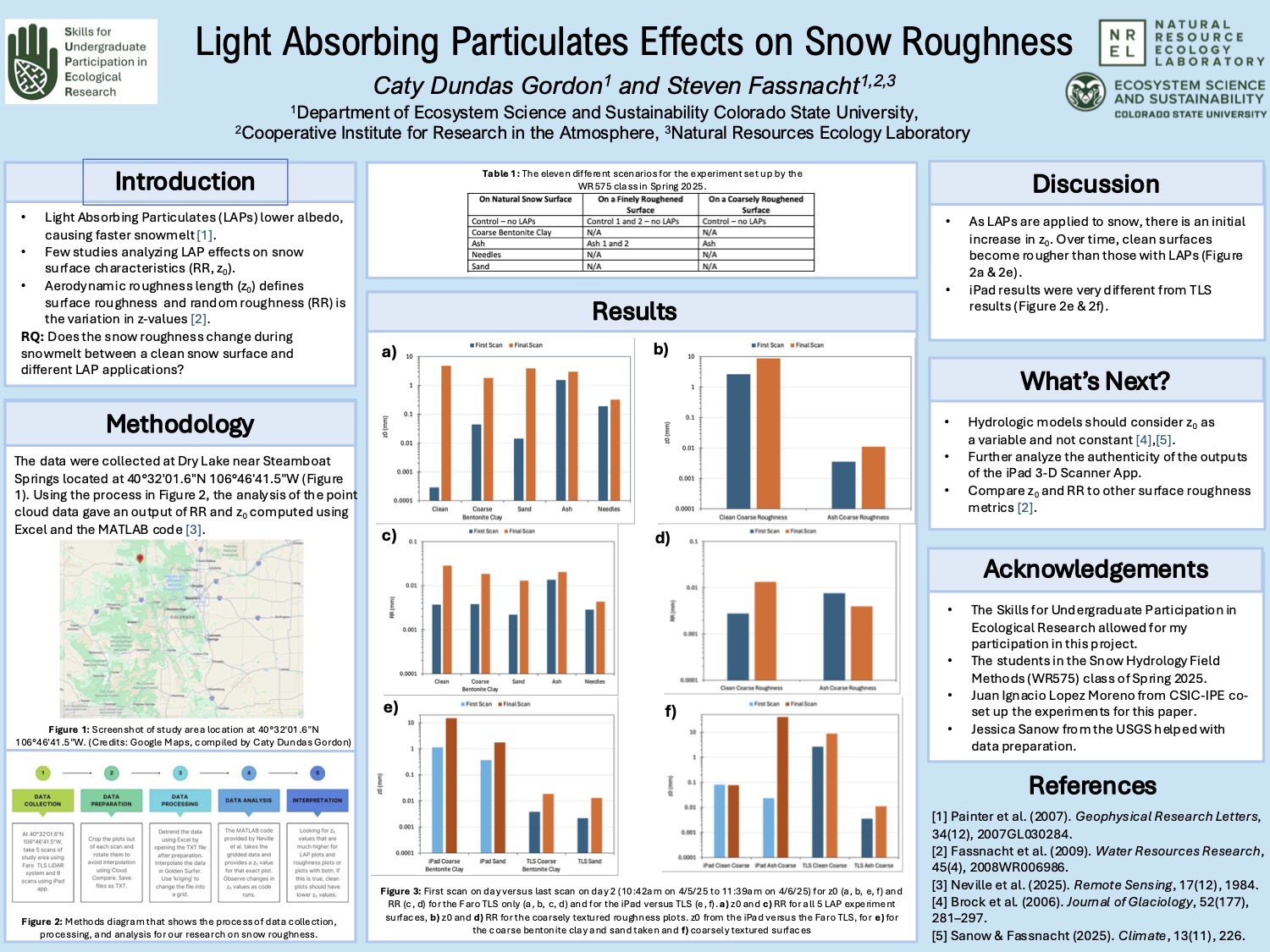
Light absorbing particulates (LAPs) can significantly reduce the albedo of a snowpack causing melt to occur more rapidly. In some areas with substantial LAPs, such as dust, the snowpack has been modeled to melt a month sooner. There have been, however, fewer studies examining the influence of LAPs on the snow surface. Since LAPs can be deposited at any time when snow is present, the LAPs can also be readily buried by new snow. But snow surface evolution can occur without melting such as by wind. We assess the effects of LAPs on snow roughness measured using two metrics: the random roughness (RR) and the aerodynamic roughness length (z0). Lower RR means a less rough surface, and considerable changes in z0 over time will impact the turbulent fluxes. Experiments were conducted at Dry Lake near Steamboat Springs, Colorado, USA over two days in early April 2025, after snowmelt had begun. A variety of treatments were applied to three different snow surfaces, with two of the surfaces having roughness features induced. Results demonstrate the differences in both roughness metrics over time and across the varied snow surfaces.