
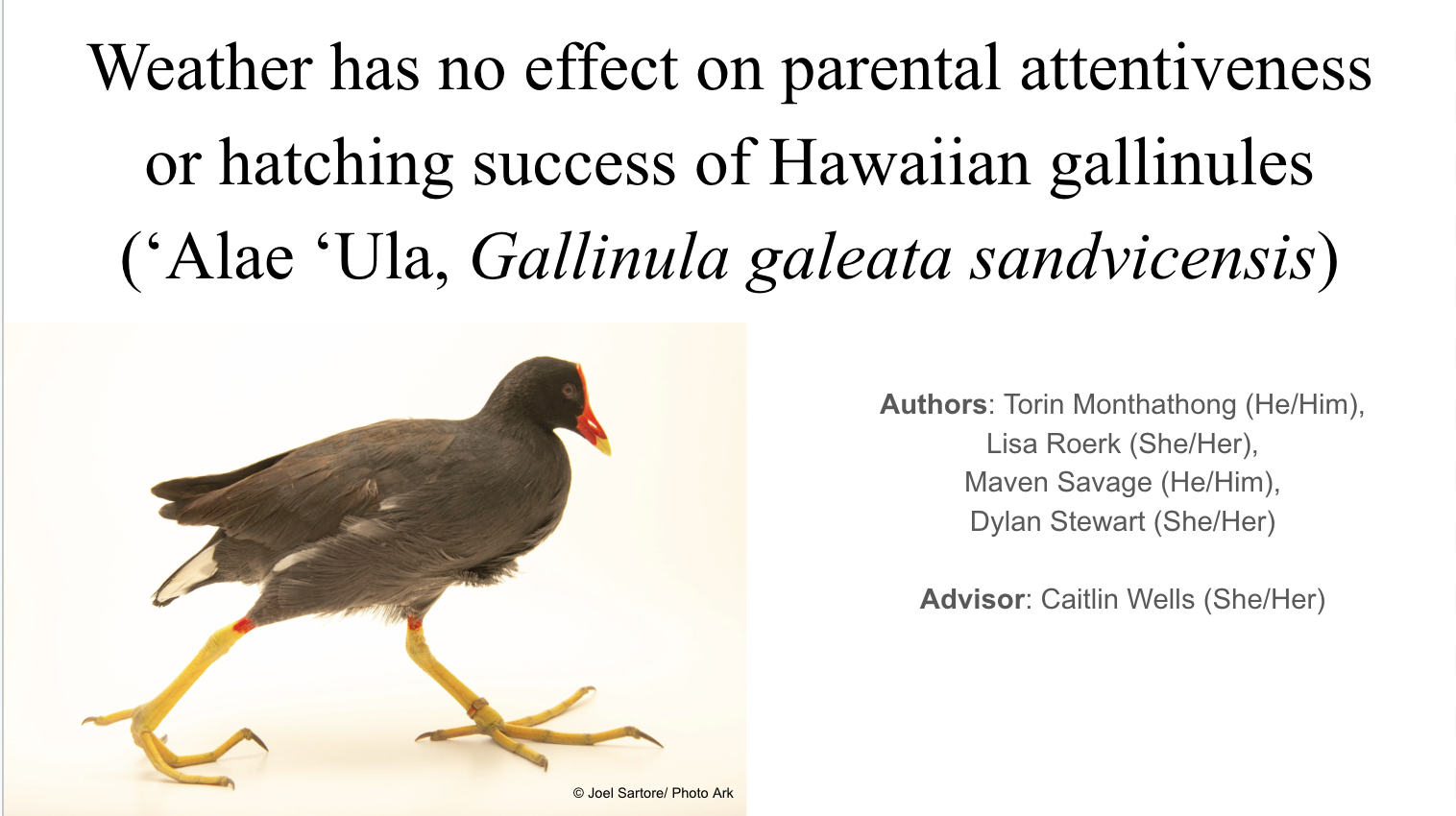
Weather has no effect on parental attentiveness or hatching success on Hawaiian gallinules ('Alae ‘Ula, Gallinula galeata sandvicensis)
Category: Oral Presentation
Author(s): Torin Monthathong, Madeline Savage, Dylan Stewart
Presenter(s): Torin Monthathong
Mentors(s): Caitlin Wells Salerno
The Hawaiian gallinule (Gallinula galeata sandvicensis), also known as ‘Alae ‘Ula, is a waterbird endemic to the Hawaiian archipelago, and is currently listed as endangered by the U.S. Endangered Species Act. This study aims to understand the effects of short-term weather patterns on parental attentiveness during incubation and how parental attentiveness affects hatching success within the Marine Corps Base Hawai’i, Oahu. We compared weather data to off-bout durations collected from motion-detected cameras and how that affected hatching success. A generalized linear mixed-effects model (GLMER) with nest as a random effect was used to understand the relationship between weather and daily total off-bout time, along with a binomial generalized linear model (GLM) to assess the effects of mean daily off-bout on hatching success. Measured weather variables did not significantly affect daily off-bout duration, and off-bout duration did not affect hatching success, but the initiation of off-bouts strongly followed a diel pattern, peaking in the early afternoon and declining sharply overnight. However, nest identity explained the majority of the variation seen in the study. The study suggests that short-term weather conditions do not strongly affect hatching success, possibly because these birds nest in a tropical environment. This will allow future research to focus on the timing of their research based on their goals, as well as to identify other possible causes of hatch failure.