
SARS-CoV-2 ORF8 Protein: Illuminating COVID-19 Origin and Effects on MHC Class I and Interferon Signaling
Category: Research Poster
Author(s): Meredith Brazeal, Brandon Schout, Logan Lowe, Megan Moran, Kaitlin McClatchey, Logan Ridenbaugh
Presenter(s): Meredith Brazeal
Mentors(s): Alan Schenkel
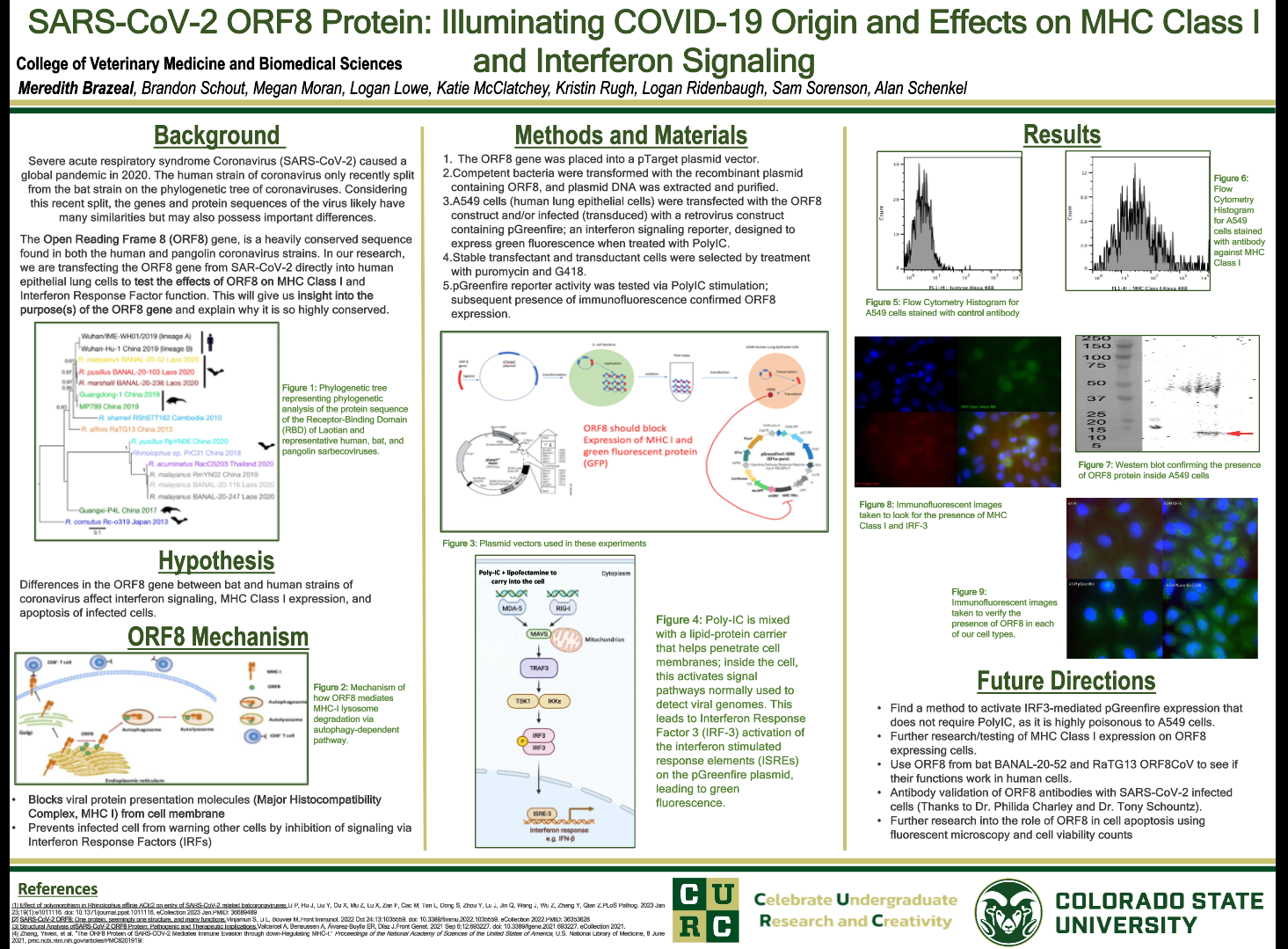
Severe acute respiratory syndrome Coronavirus-2 (SARS-CoV-2) caused a global pandemic in 2020. The genome of coronaviruses shows that the split between the bat and human strains was recent. One highly conserved gene between the bat and human strains is the Open Reading Frame 8 (ORF8). ORF8 blocks interferon signaling (via IRF3) and MHC Class I expression by trapping IRF3 and MHC Class I in the endoplasmic reticulum. Our hypothesis is that the few differences between bat and human variants may alter this ability. We made human epithelial cells expressing ORF8 and/or a green fluorescent protein (GFP) when interferon signaling is activated by viruses. We found that interferon alpha and beta did not turn on the GFP reporter. The virus genome mimic polymeric Inositol-Cytosine (Poly IC) did turn on the GFP reporter but was toxic to the cells. Our preliminary data showed less death in the cells that express ORF8 when treated with Poly-IC. We will next see if ORF8 expressing cells can be infected with SARS-C0V-2, see if the virus could turn on the GFP reporter, and if ORF8 increases or decreases viral replication. Currently we are validating that our antibody for ORF8 works and that our cells are expressing the ORF8 protein, but we have not been able to detect it. We are trying a new monoclonal antibody against ORF8, along with using control cells infected with SARS-CoV-2, and may try a different cell line moving forward. We are also staining for MHC Class I and IRF3.